Today is my 1 year Anniversary since my ATR surgery, and I can’t believe it’s already been a full year. I agree with Tom that this has been a long journey, and I am happy to say that I made it through okay.
It’s nice to see the Marathon Tracker showing that I’ve finished the race, and it says: “dennis has completed the grueling 26.2 ATR miles to full recovery”
But I know that there’s more recovery left. I’ve spoken to others who are a year ahead of me and they say that your Achilles will continue to get better. My Achilles doesn’t feel 100% recovered yet, but I play pickup basketball once or twice a week, and my Achilles doesn’t bother me.
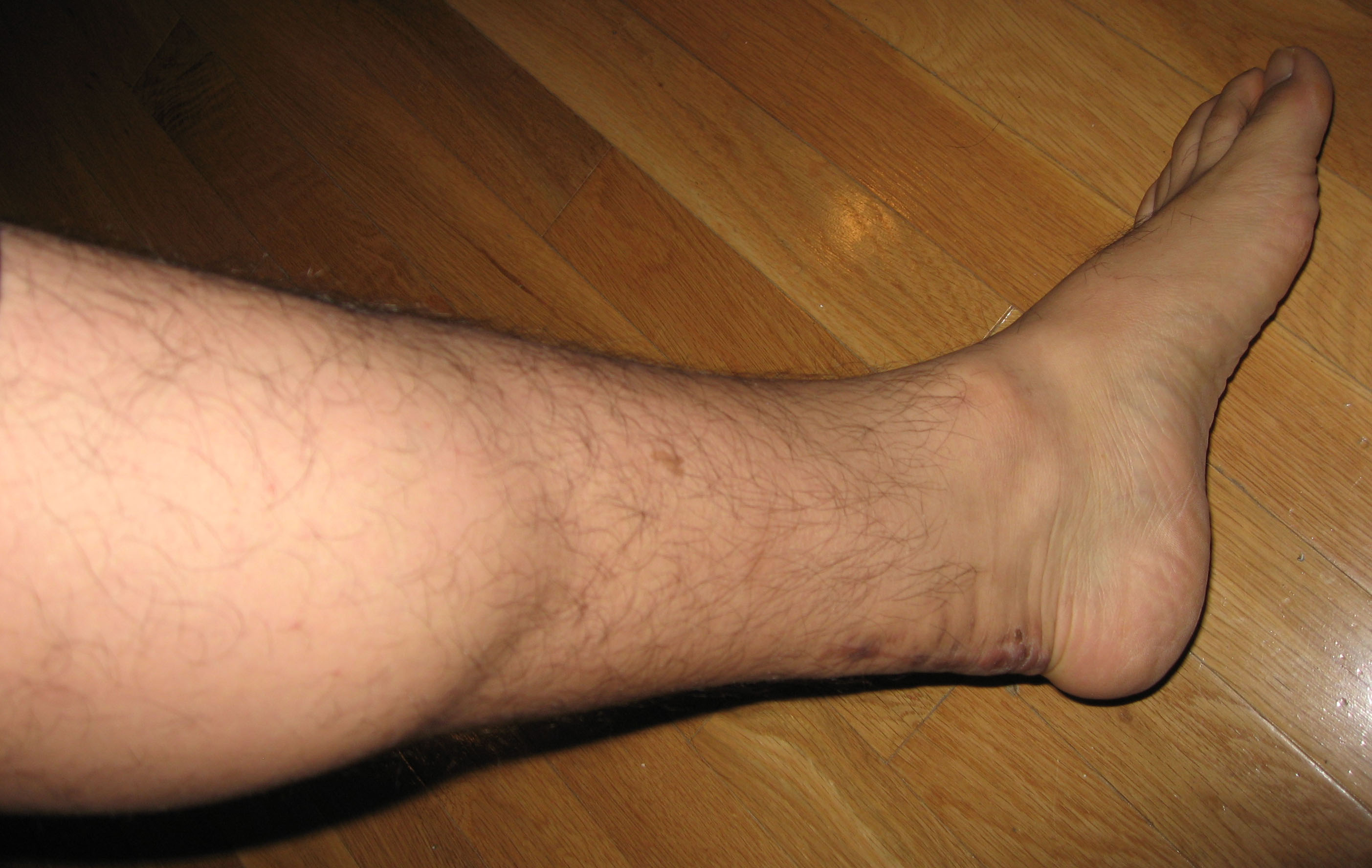
I was worried last week about my swollen Achilles near the heel, but the swelling has gone down. I think it was the ankle brace that I was wearing that must have irritated my Achilles. I played this past Sunday without it, and no swelling. I’ll keep a close eye on it tonight when I play again.
So how am I on the court?
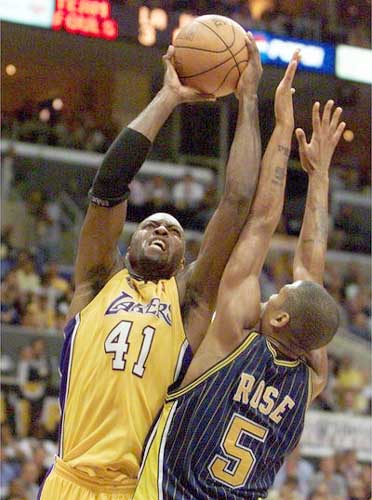
I don’t play as much defense as I used to since I make a point of not running backwards any more, when I remember. (I ruptured my Achilles running backwards on defense.) I pretty much play like Glen Rice in the later years of his career. I am now mostly a mid-range jump shooter and play just a little bit of defense. I can’t fault my recovering Achilles for this, since my right knee is the culprit that’s keeping me from running, slashing, and playing defense.
Just to recall how I was feeling a year ago, I went back to read my post about the surgery on the main site: http://achillesblog.com/chronology-of-achilles-rupture-to-recovery/surgery-day/ And the more brief, slightly different post on my own AchillesBlog: http://achillesblog.com/dennis/2008/02/12/day-4-surgery-day-my-anethesiologist-is-a-baller/
The first couple of weeks were filled with anxiety and uncertainty, and I am glad to have lived through it together with others on this site. It really made a big difference to be able to share my experiences with others.
I am glad that there are now over 300 people who have put their Achilles Profiles up. On average, there is about one person a day joining this community. It’s unfortunate that people are rupturing their Achilles almost daily (probably a lot more than that..), but it’s a good thing that they are finding useful information and finding a very supportive group of people here.
Okay, I need to sleep.. I’ll write more later on this post. 
Thanks everyone! Happy healing!
Tags: Uncategorized
Well, it’s getting close to my 1 year anniversary of my Achilles tendon rupture and my surgery date, which was 3 days after my injury, but I am afraid I have a bit of bad news. A small bump on the road, so to speak.. and literally too.
I played basketball last weeks on both Wednesday and Thursday. I played this Wednesday too, and I noticed that my Achilles tendon on my recovering foot was noticibly swollen. The bump just above the heel is more pronounced than it used to be, as recent as 2-3 weeks ago. It has been feeling a bit funny too, so I am going to abstain from any sort of physical activity for a few more days and see how my achilles feels.
The thing is though, my achilles never really hurt much. Even when I ruptured it, it didn’t hurt much so I am worried that it can be a lot worse than how my body is telling me through “pain”.
The swelling has come down a bit, but it feels a bit funny. It doesn’t feel quite right. I’ll keep you posted. I didn’t expect this kind of news after this being almost a year since the injury. Maybe back to back basketball night is no longer possible for me. Or it could be that basketball is no longer a possibility for me, period. Well, we’ll see. I’ll keep you posted. I’ll post some pictures too this weekend.
I am a little disappointed and worried, but hell I’ll take what I can get. I can still run/walk. It didn’t re-rupture. It doesn’t hurt.
My favorite day of the week was Wednesday because I always played basketball on Wednesday. My second favorite day was Thursday because I sometimes played basketball.
I hope this doesn’t discourage anyone who’s starting out on the recovery. I think most people recovering from ATR have been fine this far out on recovery. It could be temporary setback for me too. Who knows?
Tags: Uncategorized

It’s been nearly 11 months since my Achilles surgery, and my recovering Achilles feels pretty good. In fact, it feels b etter than my right Achilles, which gets tender after I play basketball.
I now play basketball once or twice a week, and I go to the gym a couple of times a week for strength training and running. I wear my ankle brace, which I think provides some protection from accidental contact.
I went skiing for a day while I was in Salt Lake City, and it felt great to be out in the mountains. I had difficulty fitting into my ski boots that I’ve had for several years, and I had to take the bottom insole out of the boot. My foot either grew after my surgery or my heel now protrudes more than it used to, jamming my toes into the tip of the boots. Without the insole, I was comfortable in the boots so that was not a problem.
Overall, I am pretty happy with my recovery progress. I am still hesitant with jumping and pushing off hard with my left leg, but that hasn’t stopped me from doing the things that I love. I still play basketball, tennis, ski, and run. My recovering Achilles feels fine after any sort of activity, but my right Achilles gets pretty sore. I have to really be careful, or I’ll be getting matching surgery scars, and I don’t want any more surgeries.
I exchanged e-mails with John and Brendan who were on this site from the very beginning. They have moved on from their injury/recovery, and they are not so focused on it as we all once were. John said that he went skiing a few times this season. He said that he didn’t have as much control of the skis at first, but he felt fine and was able to cruise at high speeds and carve some good turns. He also reduced tension on his bindings a bit too.
John mentioned getting some additional Physical Therapy and taking Pilate classes, and I am also going to look into more PT and give Pilates a try too. It’ll be beneficial for my ailing knees to strengthen my core/legs.
I still feel a bit of stiffness in my Achilles at times, but I’ve gotten used to it. I wonder if I am feeling the sutures that were used to stitch together the tendon. It’s the non-dissolvable kind so it’s still there inside me.
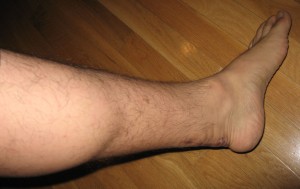
Here are some more pictures:
Yeah, the scar doesn’t look pretty, and it hasn’t improved since the last time.. Except that I am able to wear one of the dress shoes that I wasn’t able to wear a few months ago. There are some shoes that I still can’t wear, and I threw out a pair. They were old anyway.
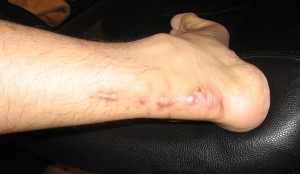
It’s more obvious from this picture that my Achilles tendon seems thicker than a normal tendon.

My left calf muscle has recovered to its original size/strength.
Thanks for reading, and if you are in the early stages of recovery, be patient and don’t get discouraged. It’ll take time, but you’ll get back to doing the things that you love in due time. Have a happy new year, and lets hope that we’ll be healthier in 2009!
Tags: Uncategorized
November 9th, 2008 · 7 Comments
Here’s a good article from NY Times about stretching: (There is also a short video on that page.)
http://www.nytimes.com/2008/11/02/sports/playmagazine/112pewarm.html?em

Illustration by Emily Cooper
STRAIGHT-LEG MARCH (for the hamstrings and gluteus muscles)Kick one leg straight out in front of you, with your toes flexed toward the sky. Reach your opposite arm to the upturned toes. Drop the leg and repeat with the opposite limbs. Continue the sequence for at least six or seven repetitions.

Illustration by Emily Cooper
SCORPION (for the lower back, hip flexors and gluteus muscles) Lie on your stomach, with your arms outstretched and your feet flexed so that only your toes are touching the ground. Kick your right foot toward your left arm, then kick your left foot toward your right arm. Since this is an advanced exercise, begin slowly, and repeat up to 12 times.

Illustration by Emily Cooper
HANDWALKS (for the shoulders, core muscles and hamstrings) Stand straight, with your legs together. Bend over until both hands are flat on the ground. ‘‘Walk’’ your hands forward until your back is almost extended. Keeping your legs straight, inch your feet toward your hands, then walk your hands forward again. Repeat five or six times.
Stretching: The Truth
By GRETCHEN REYNOLDS
WHEN DUANE KNUDSON, a professor of kinesiology at California State University, Chico, looks around campus at athletes warming up before practice, he sees one dangerous mistake after another. “They’re stretching, touching their toes. . . . ” He sighs. “It’s discouraging.”
If you’re like most of us, you were taught the importance of warm-up exercises back in grade school, and you’ve likely continued with pretty much the same routine ever since. Science, however, has moved on. Researchers now believe that some of the more entrenched elements of many athletes’ warm-up regimens are not only a waste of time but actually bad for you. The old presumption that holding a stretch for 20 to 30 seconds — known as static stretching — primes muscles for a workout is dead wrong. It actually weakens them. In a recent study conducted at the University of Nevada, Las Vegas, athletes generated less force from their leg muscles after static stretching than they did after not stretching at all. Other studies have found that this stretching decreases muscle strength by as much as 30 percent. Also, stretching one leg’s muscles can reduce strength in the other leg as well, probably because the central nervous system rebels against the movements.
“There is a neuromuscular inhibitory response to static stretching,” says Malachy McHugh, the director of research at the Nicholas Institute of Sports Medicine and Athletic Trauma at Lenox Hill Hospital in New York City. The straining muscle becomes less responsive and stays weakened for up to 30 minutes after stretching, which is not how an athlete wants to begin a workout.
THE RIGHT WARM-UP should do two things: loosen muscles and tendons to increase the range of motion of various joints, and literally warm up the body. When you’re at rest, there’s less blood flow to muscles and tendons, and they stiffen. “You need to make tissues and tendons compliant before beginning exercise,” Knudson says.
A well-designed warm-up starts by increasing body heat and blood flow. Warm muscles and dilated blood vessels pull oxygen from the bloodstream more efficiently and use stored muscle fuel more effectively. They also withstand loads better. One significant if gruesome study found that the leg-muscle tissue of laboratory rabbits could be stretched farther before ripping if it had been electronically stimulated — that is, warmed up.
To raise the body’s temperature, a warm-up must begin with aerobic activity, usually light jogging. Most coaches and athletes have known this for years. That’s why tennis players run around the court four or five times before a match and marathoners stride in front of the starting line. But many athletes do this portion of their warm-up too intensely or too early. A 2002 study of collegiate volleyball players found that those who’d warmed up and then sat on the bench for 30 minutes had lower backs that were stiffer than they had been before the warm-up. And a number of recent studies have demonstrated that an overly vigorous aerobic warm-up simply makes you tired. Most experts advise starting your warm-up jog at about 40 percent of your maximum heart rate (a very easy pace) and progressing to about 60 percent. The aerobic warm-up should take only 5 to 10 minutes, with a 5-minute recovery. (Sprinters require longer warm-ups, because the loads exerted on their muscles are so extreme.) Then it’s time for the most important and unorthodox part of a proper warm-up regimen, the Spider-Man and its counterparts.
“TOWARDS THE end of my playing career, in about 2000, I started seeing some of the other guys out on the court doing these strange things before a match and thinking, What in the world is that?” says Mark Merklein, 36, once a highly ranked tennis player and now a national coach for the United States Tennis Association. The players were lunging, kicking and occasionally skittering, spider-like, along the sidelines. They were early adopters of a new approach to stretching.
While static stretching is still almost universally practiced among amateur athletes — watch your child’s soccer team next weekend — it doesn’t improve the muscles’ ability to perform with more power, physiologists now agree. “You may feel as if you’re able to stretch farther after holding a stretch for 30 seconds,” McHugh says, “so you think you’ve increased that muscle’s readiness.” But typically you’ve increased only your mental tolerance for the discomfort of the stretch. The muscle is actually weaker.
Stretching muscles while moving, on the other hand, a technique known as dynamic stretching or dynamic warm-ups, increases power, flexibility and range of motion. Muscles in motion don’t experience that insidious inhibitory response. They instead get what McHugh calls “an excitatory message” to perform.
Dynamic stretching is at its most effective when it’s relatively sports specific. “You need range-of-motion exercises that activate all of the joints and connective tissue that will be needed for the task ahead,” says Terrence Mahon, a coach with Team Running USA, home to the Olympic marathoners Ryan Hall and Deena Kastor. For runners, an ideal warm-up might include squats, lunges and “form drills” like kicking your buttocks with your heels. Athletes who need to move rapidly in different directions, like soccer, tennis or basketball players, should do dynamic stretches that involve many parts of the body. “Spider-Man” is a particularly good drill: drop onto all fours and crawl the width of the court, as if you were climbing a wall. (For other dynamic stretches, see the sidebar below.)
Even golfers, notoriously nonchalant about warming up (a recent survey of 304 recreational golfers found that two-thirds seldom or never bother), would benefit from exerting themselves a bit before teeing off. In one 2004 study, golfers who did dynamic warm- up exercises and practice swings increased their clubhead speed and were projected to have dropped their handicaps by seven strokes over seven weeks.
Controversy remains about the extent to which dynamic warm-ups prevent injury. But studies have been increasingly clear that static stretching alone before exercise does little or nothing to help. The largest study has been done on military recruits; results showed that an almost equal number of subjects developed lower-limb injuries (shin splints, stress fractures, etc.), regardless of whether they had performed static stretches before training sessions. A major study published earlier this year by the Centers for Disease Control, on the other hand, found that knee injuries were cut nearly in half among female collegiate soccer players who followed a warm-up program that included both dynamic warm-up exercises and static stretching. (For a sample routine, visit www.aclprevent.com/pepprogram.htm.) And in golf, new research by Andrea Fradkin, an assistant professor of exercise science at Bloomsburg University of Pennsylvania, suggests that those who warm up are nine times less likely to be injured.
“It was eye-opening,” says Fradkin, formerly a feckless golfer herself. “I used to not really warm up. I do now.”
You’re Getting Warmer: The Best Dynamic Stretches
These exercises- as taught by the United States Tennis Association’s player-development program – are good for many athletes, even golfers. Do them immediately after your aerobic warm-up and as soon as possible before your workout.
STRAIGHT-LEG MARCH
(for the hamstrings and gluteus muscles)
Kick one leg straight out in front of you, with your toes flexed toward the sky. Reach your opposite arm to the upturned toes. Drop the leg and repeat with the opposite limbs. Continue the sequence for at least six or seven repetitions.
SCORPION
(for the lower back, hip flexors and gluteus muscles)
Lie on your stomach, with your arms outstretched and your feet flexed so that only your toes are touching the ground. Kick your right foot toward your left arm, then kick your leftfoot toward your right arm. Since this is an advanced exercise, begin slowly, and repeat up to 12 times.
HANDWALKS
(for the shoulders, core muscles, and hamstrings)
Stand straight, with your legs together. Bend over until both hands are flat on the ground. “Walk” with your hands forward until your back is almost extended. Keeping your legs straight, inch your feet toward your hands, then walk your hands forward again. Repeat five or six times. G.R.
Tags: Uncategorized
November 3rd, 2008 · 4 Comments
Tags: Uncategorized