• Today's Poll

    Did you take a fluoroquinolone type antibiotic (Cipro, Levaquin, Floxin, etc.) within a year prior to your Achilles tendon rupture?
    Yes
    No
      
    pollcode.com free polls
  • Photos

    Week 6

    Week10

    Week12

    Week16

    5 Months

    6 Months

    7 Months

    8 Months

    9 Months

    10 Months

    11 Months

    1 Year

Fitness Update

gym_thumb.jpg

I rejoined the gym earlier this week in hopes of expanding my fitness regimen now that I’m getting around a little better.  Usually around this time of year I’m cancelling my membership, eager to be active outdoors.  But, this year I’ll spend a bit more time indoors at the gym trying to rebuild the strength in my leg.

I went to the gym on Saturday and it felt really good to be back.  I’m guessing it’s just another one of those feelings of normalcy.  It was also nice to do something active that didn’t involve my bike trainer.  After doing a bit of stretching, I hopped onto an elliptical machine to do a bit of cardio work.  I figured the elliptical would provide a good, no impact workout for the legs and also get my heart rate going. 

The first 20 minutes on the elliptical went well.  I started to feel a little bit more strain on the tendon during the last 5 minutes of my workout.  But, overall I would say the elliptical is a pretty good rehab option.  I have just a few thoughts:

1.  I’m not sure I’d use the elliptical too much prior to around week 10 post op, at least under a rehab protocol similar to mine.  It’s difficult to control your stride length without going to a high level of resistance, so you could over stretch the tendon and cause some pain.

2.  Back pedalling on the elliptical produces a bit more strain than pedalling forward.  Be careful when back pedalling.

3.  The elliptical provides a lot of different setting options.  I just used one of the preset cross training programs, but you could program your own workout to isolate the calves.

4.  It may be possible to use the elliptical while in the boot.  Do not attempt this without first speaking to your doctor.  But, the foot holds on the elliptical are rather large, and might work with the boot.  I’m not sure how the movement would feel while in the boot, but it could be worth a try, if your doctor agrees.

After the elliptical I worked on the stretching, strengthening, and balance exercises that I’ve been doing in PT.  One of the areas I’ve focused on this week has been stairs.  So, I’m doing several step exercises which seem to be helping.  I think it will continue to be a bit awkward until I’m able to keep more weight up on my toes.

I returned back to the gym this morning to try out some pool exercises.  I worked mainly in chest to shoulder depth water and felt like I got a good workout.  I did some single leg heel raises, jogged a bit, and hopped around on the injured leg.  I also tried some single leg heel raises in waist deep water, but I needed to use my arms to hold some of the weight.  I didn’t attempt much swimming other than a couple lengths of the pool.  It felt a little uncomfortable with my foot kicking around on the surface of the water, so I decided not to push that right away.  A couple of thoughts on the pool:

caddyshack_doody.jpg

1.  It seems like it would be very difficult to get around safely on crutches.  I thought this was also true with the shower room.  You may want to ask your gym if they have a wheelchair that you could use to get to the edge of the pool.  Getting out of the pool safely also seems like a bit of a challenge.

2.  The pool seems like a great way to start working the leg once you start weightbearing.  My doctor had suggested using the pool earlier in my recovery, but I was hesitant because I didn’t want to spend the money on the gym membership if I found that using the pool wasn’t right for me.  In hindsight, I wish I would have started using the pool about a month ago, probably some time around week 8 post op.

So, I plan to work the pool exercises into my workout routine.  I figure maybe 3 days in the water and 3 days on dry land.  I’ll see how that feels after a week and then make some adjustments.

 aaron_ruell8.jpg

Jim asked the question the other day about what outdoor exercises will be good to start with, metioning biking and rollerblading as options.  I’m also curious what others think.  Biking will most likely be my activity of choice until I can start running again.  I also think I’ll do a bit more hiking over the next couple of months.  One thing that kind of caught me off guard was the feeling of walking on uneven surfaces.  Not that it has been uncomfortable, but just a weird feeling with all the muscles in the foot and leg learning again how to fire at the right time to keep balanced.  I think hiking will be a good challenge for regaining balance.

Week 12 Update

Well, I’m now at week 12 post op.  I’m considering this a bit of a milestone because it seems like this is the point people start referring to their recovery status in months rather than weeks.  So, here’s my update at 3 months.

Nothing too significant has occurred since my week 10 post op visit.  It has now been 3 weeks since I got back into a PAIR of shoes (it’s soooo nice to be able to say that again), and I’m getting around pretty well.  I’m still walking with a limp, but it’s getting better.  About three quarters of the way through my stride, the point where I push off with my toes, it feels like someone is pinching my ankle.  On a good day I can almost eliminate the limp when I’m walking very slow.  However, most days I continue to feel every step I take.

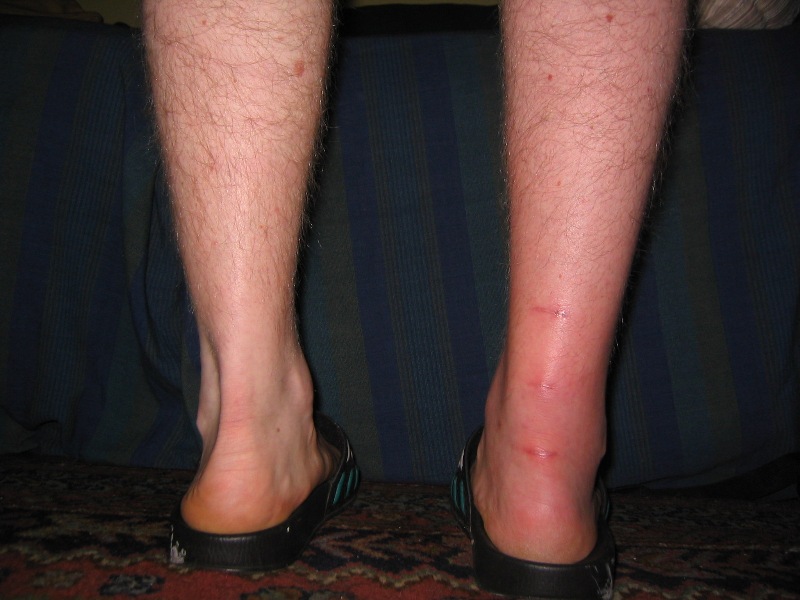
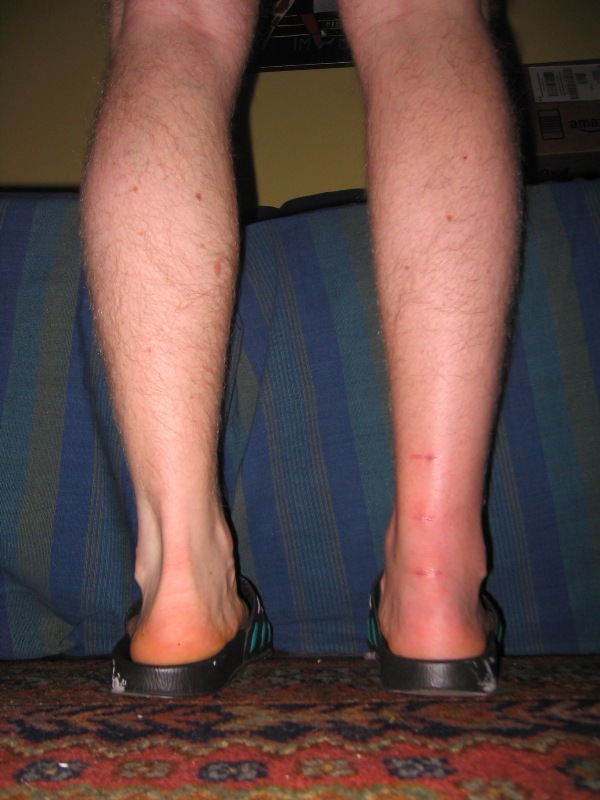
I’ve managed to get a bit of definition back in my calf although there is still not a tremendous amount of strength.  The lack of strength is most noticeable when trying to put weight onto the toes.  There is just not much of a spring in my step.  But, I know with hard work this will return.  Here are a couple pictures comparing my legs (I promise I’m wearing shorts!):

picture-002a.jpg

picture-017a.jpg

 As you can see, the tendon area is very thick in comparison to my uninvolved leg. 

I’ve now had two weeks of physical therapy (two sessions per week).  Since I got a bit of a late start with PT, my sessions are concentrated more with strengthening exercises rather than range of motion.  I still do a lot of ROM at home and while I’m sitting at the office, but I’ve also been able to add in various strengthening exercises.  I was pleased to start doing some leg presses last week, albeit with low weight.  They’ve also got me using some contraption with several springs and pulleys.  I think they called it a pilates reformer, but whatever the name, I notice quite a nice burn when I finish a set of exercises.  Starting next week I may only go in for PT once a week.  The rest will be up to me.  I’ve renewed my gym membership so that I have a few more options than what I’ve got around the house for strengthening.  I’ll probably also try out the pool.

Walking unaided again has been pure joy.  I really enjoyed the comment someone previously made about it taking a low point in our lives, such as an injury, to really appreciate the good things we have.  It also allows us to identify some simple pleasures we start to miss. Running, jumping, driving, bar hoppin’ are a few obvious pleasures that come to mind, but I was actually thinking a bit deeper.

My partner, without complaint, shouldered the extra load around the house while I was unable to freely ambulate for some 2 months. Have I mentioned before how great she’s been during my recovery?? I have to admit that there were times when it felt pretty good having a legit excuse for avoiding some chores. But, guilt did set in after awhile as well as a need to return to normalcy. That’s when missing one particular simple pleasure hit home.

Walking the dog is one of the “chores” we split, one of us taking the morning shift and the other taking the evening shift. However, my partner took on the burden of walking the dog twice a day while I was laid up, ensuring that our pooch would get enough exercise. There were several subzero mornings when I wasn’t too troubled that I couldn’t walk the dog. But, as we started to experience a few brief thaws it was getting harder and harder to look the dog in the eyes and hope she’d understand why I wasn’t taking her out to play. Okay, I realize that non dog owners are thinking I’m a little crazy, but stay with me. It’s probably a little like not being able to play with your kids the way you’re used to.

Anyway, we had some warmer weather a couple weeks ago that was enough to melt most of the snow and ice off the sidewalks and build my confidence that it was safe to take a short walk with the dog. So, I laced up my shoes (again, it’s really nice to pluralize shoe after so long - another simple pleasure, I guess), grabbed the leash and headed out the door with the dog.

It wasn’t a very long walk, I only made it around the block. But, the two of us were happy that I was finally back on my feet again. It is a feeling that I plan to keep in the back of my mind to remind myself anytime that I’m feeling too tired, too cold, too old, or too sore to go for a walk.

Since that time I’ve been able to take a few more longer walks.  I don’t push things too hard and only go about a mile or so, but it feels better and better each time.  Probably more so mentally than physically.  I’m hopeful by the time May roles around I’ll be able to take the dog out for a nice, slow jog!

Response to Brendan’s Discussion Topic

Brendan has posted a fantastic discussion topic!  Here is the link.  I knew my response to the topic would be lengthy, so I thought I would write a post rather than a comment on Brendan’s page.  I’ve given a lot of thought to rupturing my other AT or a possible re-rupture over the past three months.  My conclusion - I’ll likely won’t change much, assuming my recovery continues to progress well.  If there are products available or strengthening/stretching techniques that help minimize the risk of a rupture, I will give them a try.  But, I won’t likely change my level of activity.

Being active and involved with sports is a huge part of who I am.  While this injury made me realize I’m not bullet proof (far from it) and that I’m getting older, I cannot see giving up any of the activities I did before the injury.  Life is too short to give up the things we love.  However, we can be smarter about doing the things we love. I will probably take more time in the future to stretch out prior to physical activities (at least initially until I start thinking I’m bullet proof again) and I will try to do a better job of working all my muscle groups.

My physical therapy clinic offers a running program for runners battling injuries.  I’m hopeful that I will be able to take advantage of this program toward the end of my physical therapy sessions.  The program analyzes your stride and running technique to see if there are adjustments that can be made to be a more efficient runner and hopefully avoid future injuries.  They also make suggestions for footwear to ensure any pronation is controlled properly.  Perhaps this program may find something that put me more at risk for a rupture and provide tips for reducing the risk of another rupture.

With that being said, I’m still a believer that it was just my time.  Even if I would have stretched out better the night of the rupture or wore beater footwear, I still believe a rupture was inevitable.  If it didn’t happen on January 3, 2008, it probably would have happened a month, or a year or several years later.  I have been active all of my life and I’m sure I’ve thoroughly abused my Achilles tendons over the years.  I also think genetics plays a part.  My father rupture his AT 12 years ago.  Perhaps this is just dumb luck, but I’m guess there is something in our genes that made us more at risk.  I read a few articles that mentioned some people can simply have a collagen deficiency.

Anyway, since my father’s rupture, I’ve always been more aware of my Achilles tendons.  For the last decade I’ve felt an occasionally tightness in the tendons, usually first thing in the morning or after sitting for a long period of time.  This occurs maybe once a month at most.  The tendons feel stiff until I take a step that stretches them out a little.  Usually the stretching step is the first step when going down a flight of stairs.  I’ll feel a slight pop (nothing like the “pop” we’re now all to familiar with, but one similar to cracking a knuckle) and then everything would be fine again.  Though I mentioned this to my doctor, he didn’t have much of an explanation.  It could be tendinitis/tendinosis, but there really are no other signs and definitely no pattern.  Over the years I sort of accepted the fact that I may some day experience a rupture.  Therefore, it was maybe a little bit easier for me to accept the injury when it happened.  Don’t get me wrong, I was mad as hell and still shocked when it popped, but my focus shifted quickly to rehab.

I guess I’ve also accepted the fact that there is a decent chance I may rupture my left AT someday.  If genetics and overuse affected my right AT, well than my left might not be too far behind.  The good news for me is that my father has not suffered another rupture and he remains very active, so maybe this is a good sign.

As I mentioned before, there are some things I will do to hopefully minimize the risk of another rupture, but I really won’t change my lifestyle.  There is some pain involved with this injury, but I’d feel far more pain if I started to avoid a daily run or shooting hoops or spiking a volleyball.

I hope this hasn’t come off as me believing that we’re all doomed.  Far from it.  I guess what I’m trying to say is that we’re all living proof that recovery is possible.  Some days it may not seem that way, but a few years down the road we’re going to struggle to remember if we were NWB for 4 weeks or 6 weeks.  The odds are in our favor that we’ll all recover fully and resume our pre-injury level of activity.   Just try to stay positive!

Drivin’ Me Crazy

90072536.jpg 

 I ruptured my right AT and my car is a manual transmission, so I was pretty screwed when it came to driving after my injury.  I’m guessing a few others who have ruptured their right AT know the feeling.  The topic of driving has come up a few times on achillesblog.com sites, so I thought I’d share my experiences.

I’m lucky enough to have a wonderful girlfriend who shuttled me around after the injury.  I owe her big time, and I’m guessing she’ll remind me from time to time!  My parents also live relatively close so my father helped with transporting me to and from work.  This worked out pretty well although I felt like a terrible burden no matter how many time my parents and partner insisted I wasn’t.

At around week 6 post op I started to feel very restless and was sick of being completely dependant upon others.  So, I decided I wanted to try and drive left footed.  As a little background, my father ruptured his AT (right side) about 12 years ago and he started to drive left footed shortly after the surgery.  He couldn’t work from home and he had a long commute, so it wasn’t practical for my mother to drive him.

Anyway, I figured if my father could drive left footed, then I should be able to as well.  The only problem was that both my partner and I drive manual transmissions.  Fortunately, my father could sympathize with my situation and he agreed to swap cars with me.  We went to an open parking lot one Saturday afternoon, just so I could get comfortable driving with the other foot.  Within a few minutes I was out on the open road, feeling pretty comfortable.

My partner was not to thrilled with me driving left footed, but I think she understood my restlessness.  I agreed to limit the driving to my daily commute and to not drive when it snowed.  I also decided to drive the speed limit for the first time since getting my driver’s license.  I thought that might make up for any reduced reaction time.

I drove incident free with my left foot from week 6ish to week 9.  The toughest part was getting used to driving my father’s car that had a much more sensitive gas pedal.  It was actually kind of fun driving around following the speed limits, although I’m sure the cars stacked up behind me weren’t all that thrilled!  In so many ways this injury has forced me to slow down.  While driving slowly, I was able to tell myself that getting to work a couple of minutes faster just didn’t really matter that much.

At week 9 I was able to transition out of the boot and back into regular shoes.  I was also getting a little tired of driving my father’s larger, less fuel efficient vehicle, so I decided it was time to get my car back.  I had regained enough range of motion that I felt I could handle driving my manual transmission.  What I didn’t appreciate, however, was just how much calf strength I had lost. 

For those familiar with driving a manual transmission, it takes a bit of practice to feather the gas pedal just right to avoid peelin’ out or killin’ the engine.  Having lost a bit of agility after being immobile for so long, it was a little awkward driving my car again.  Not wanting to stall the car, I would attempt to hit the gas a little harder than usual.  However, lacking calf strength, I quickly realized that I was barely giving the car enough gas to keep from stalling.  I’m sure it probably looked pretty funny to anyone watching.  It took several days to get the right touch back, but now I’m driving comfortably again.  I even took a 5 hour road trip this past weekend.

So, driving left footed is possible.  However, I absolutely don’t want to make it sound like I advocate doing so.  If you have other means of transportation, it is best to use them.  I think your reaction time is slowed when driving with your left foot, so high speed driving should be avoided.  As with everything else during the recovery process, you should consult with your doctor before trying to drive.  Also, you may want to contact your insurance company to see if there are any coverage issues with driving left footed. 

Discussion Topic

cartoon2.jpg

I wanted to thank Brendan and Dennis again for their hard work in putting together the Achillesblog Rehab Tracker and the Achillesblog Summary Table. Links to those two items can be found on the left sidebar.

When I read through the data the number of left foot vs. right foot ruptures listed in the Rehab Tracker caught my eye. Of those reporting, 70% of the ruptures occurred in the left foot. This got me thinking a little bit. I believe one of the many journal articles I’ve read over the last couple of months made mention of ruptures occurring more frequently in the non-dominate foot. This was true in my case. I ruptured my right AT, and I am left footed.

So, I thought I’d throw out the topic for discussion. Did your rupture occur in your dominate or non-dominate foot? In case you’re wondering, your dominate foot is the one you naturally kick with. I’ve changed the poll on the left sidebar so you can enter your response there. Or, feel free to leave a comment indicating whether you injured your dominate or non-dominate foot.

Exercise

exercise-posters.jpg

The discussion about exercise has come up a number of times on achillesblog over the last several weeks.  So, I thought I would take a minute to reflect on some of the things that I was able to do during the first 10 weeks of my recovery.  Keep in mind that this is only my experience, and you should consult with your doctor and/or therapist about what exercises are appropriate for you.

I had been in very good physical condition prior to my injury.  About 4 years ago I started to get into long distance running and since then I’ve completed a couple of marathons and numerous half-marathons.  I also do a fair amount of biking to supplement my running.  So, my cardio level has been pretty good.  Following the rupture I was able to quickly accept the fact that I would lose most of the cardio I had built up for the last several year.  I’m okay with this, because I know it will provide motivation once I’m able to start running again. 

With that being said, I still wanted to try and keep some level of fitness while I was in casts and the boot.  I really didn’t do much the first two weeks following surgery as my focus was on getting back to work and a level of normalcy.  My exercising consisted mainly of propelling myself around on crutches.  This actually provided a pretty good workout.

At my 2 week post op appointment I transferred from a splint into a cast and briefly spoke with my surgeon about things I could do to stay in shape.  I was still non-weightbearing (NWB) at this point, so there wasn’t much I could do that involved the injured leg.  My surgeon suggest to keep moving my toes around (up and down) and to do leg lifts.  I could also weight lift with other parts of my body, as long as I remained NWB.  I’ve never been much of a weightlifter, so I stuck mainly to the leg lifts.  I was still getting a pretty good workout from the crutches.

I had another post op visit at week 4 when I was recasted with my foot back in a neutral position.  I was also given the okay to start partial weightbearing and my doctor allowed me to start riding an exercise bike, if it felt comfortable.  Well, my bike was sitting in a trainer in my basement since winter set in, just waiting to be ridden.  So, that night I carefully hopped back into the saddle and went for a ride, albeit relatively short.

I rode my bike about 4 times a week for the next two weeks, slowly increasing my rpm and resistance.  I also continued to do some leg lifts during these two weeks.  I went back to the doctor at week 6 post op and moved into the boot.  My doctor encouraged me to keep riding the bike and told me I could even ride the bike without the boot if I felt comfortable.  He also encouraged pool exercises now that the incisions had healed.  He said to start in shoulder depth water trying to walk slowly and trying to do heel lifts.  Unfortunately, I let my gym membership lapse several months back, so I didn’t have access to a pool.  I also wasn’t driving at this point and I didn’t want to be a burden on my family, asking them to take me to the pool.  In hindsight, it may have been good to renew my membership and at least make a couple of trips to the pool.

Wearing the boot also allowed me to start some range of motion exercises.  These exercises were pretty basic and can be seen on the first page of this exercise guide.  I was also given the okay to start full weightbearing while wearing the boot.  Just walking around in the boot provided some great exercise.  The injury has given me more respect for walking as a good form of exercise.

I’m now beginning week 11 post op and I continue to ride on my bike trainer.  I’m almost back to the same resistance and rpm I was at prior to the surgery.  Biking works well because it doesn’t put a lot of strain on the tendon.  I’ve done some work with therabands as well over the last few weeks to improve range of motion and start the slow process of rebuilding the calf muscle.  I’m also in physical therapy now where the focus will be on rebuilding strength and getting back to my pre-injury level of fitness.

I’m sure my level of fitness has dropped quite a bit since the injury occurred, but I still feel pretty good.  I’ve lost a lot of strength, but I feel good about my cardio level at this point.  I also don’t think I’ve gained any weight, which is good. Most importantly, exercising has helped me mentally.  Every little thing that I can do to get back to a level of normalcy allows me to accept that the injury happened and that I can now move on and focus on walking normally again.

Physical Therapy - Day 1

physical_therapist.gif

I attended my first physical therapy session this evening. All in all it was pretty uneventful. I think I was expecting they would do a little more based on what others have described. To start off they tried to establish a baseline for where my ankle and tendon were at. This consisted of taking different angle measurements of both my bad and good foot. The measurements were very comparable except for the dorsiflexion (toes toward the shin) angle. My injured foot just breaks the neutral position while my good foot flexes about 15 degrees from neutral.

Next the therapist did some strength tests to compare the injured leg to the good leg. The therapist applied force to my foot from 4 different directions while I tried to apply a resisting force. The only area where I seemed to be lacking a little bit of strength was when pushing down to resist an upward force. This was to be expected from the loss of calf muscle.

The therapist seemed to imply that I was further along than she expected. I think this is probably due in part to the fact that I’m starting PT after week 10. I spent weeks 6-10 working on ROM exercises at home so the main focus for my therapy will be rebuilding both eccentric and concentric strength and returning to a normal gait.

After going through the baseline tests I worked on a few stretches and strengthening exercises as well as balance. These are exercises that I’ll continue to do at home.  The exercises are very similar to the ones originally posted by Doc Ross and can be seen here.

No massage for me this time. I’ll have to ask about that when I go back later this week. The therapist didn’t seem overly concerned about scar tissue build-up, so maybe I’ve been able to break some of that down on my own over the last several weeks.

Operation Report

A few others have posted their operation reports on their respective blogs, so I thought I’d add mine as well. I’m not sure if there is any valuable data in here, but it may be interesting to compare with the other reports. The report also gives a little more detail about the less invasive procedure performed by my surgeon, including some information about the suture technique. Feel free to leave a comment if you have any questions regarding the procedure.

DATE OF SERVICE: 01/09/2008
PREOPERATIVE DIAGNOSIS: Right Achilles tendon rupture.
POSTOPERATIVE DIAGNOSIS: Right Achilles tendon rupture.
PROCEDURE PERFORMED: Percutaneous repair, right Achilles tendon.

INDICATIONS FOR OPERATION: This is a 34-year-old active engineer who ruptured his right Achilles tendon six days ago playing volleyball. I saw him in the office on Monday, and we discussed the merits of operative versus nonoperative management. He would like to proceed with operative repair to decrease his rate of a rupture and hopefully improve his final outcome in terms of strength so that he can continue to run and jump. He is now admitted for percutaneous repair of his right Achilles tendon.

FINDINGS: The patient had a small amount of ecchymosis about his hindfoot. He had a palpable defect in his Achilles tendon as well as a positive Thompson sign. The repair was performed with the patient in the prone position using three 1 cm horizontal incisions. The first incision was made directly at the site of the rupture and the other two incisions were made 5 cm proximal and 5 cm distal. The most proximal incision was placed on the medial side of the tendon to avoid a possible injury to the sural nerve. The tendon was repaired with two square box sutures placed percutaneously with the ankle in maximum plantarflexion. The sutures were reapproximated restoring continuity at the tendon. The ankle was then immobilized in plantarflexion in a short leg plaster.

DESCRIPTION OF PROCEDURE: The patient was seen in the preop area where his identity was confirmed, his operative site was marked and his consent was reviewed. He was brought to surgery. He was given prophylactic antibiotics (1 gm Ancef). He was intubated and then placed in the prone position. His right foot was prepped and draped in the sterile fashion with his leg supported on an operating room positioning aid so that his hindfoot was free.

A skin marker was used to outline three horizontal incisions placed as described above. The incisions were made with a #15-blade scalpel and the subcutaneous tissue gently spread especially proximally to avoid an injury to his cutaneous nerves.

A #2 Fiberwire suture was then utilized on a free needle. It was passed from the middle incision at the site of the defect out the proximal incision. A grasping stitch was then placed horizontally across the musculotendinous junction and then returned down the opposite site to exit the middle wound. The same suture was then passed back into the middle wound, out the distal incision, across the distal tendon, and then back up to the middle wound, thereby creating a box type of suture.

A second stitch was then placed in the exact same manner except from the opposite side of the tendon.

With the ankle kept in maximum dorsiflexion with the towels, and with my nursing assistant retracting one suture, I tied the opposite suture. The second suture was then tied. I took care to make sure there were no adhesions between the sutures and the subcutaneous tissue. With the ankle in plantarflexion the horizontal incisions were all coapted naturally. They were nonetheless closed with a subcutaneous Vicryl suture and Steri-Strips. The tendon was palpably taut. The Thompson test was now negative, i.e., squeezing the calf was associated with plantarflexion of the ankle documenting continuity of the tendon. The wound was dressed with sterile bandages and then a Robert Jones plaster splint was applied to the foot in the resting position of about 20 degrees of equinus. He was then returned to the supine position, extubated, and brought to the Postanesthesia Care Unit (PACU) in stable condition.

The plan will be to discharge him home. He will be seen in the office in two weeks. At that time, we will anticipate placing him in a short-leg cast for another few weeks and then slowly bring him up to neutral position. We will not allow weightbearing for six to eight weeks.

Scarred For Life

Incisions at Week 10

Everyone else has been showing off their war wounds, so I thought I’d join in.  Although, I obviously won’t win any braggin’ rights.  This picture was taken after my week 10 post op visit.  As you can see and as I’ve commented before, my surgeon uses a less invasive approach when repairing Achilles ruptures.  Here is a link that describes a surgical process that was pretty similar to mine.  The less invasive approach minimizes the risk of infection and also damages less soft tissue allowing better blood flow during the healing process.

I was a little concerned early on because I didn’t read about many others who had experience with this type of surgery.  But, I had confidence in my surgeon and I liked the idea of less scarring.  I’ve read stories from others who have experienced some discomfort from shoes rubbing against the scar as they started to run again.

Anyway, I’m pleased with the results of the surgery.  I didn’t experience any complications such as infection or sural nerve damage.  So far, so good!

How Did I Get Here?

It took several weeks to be convinced that I should share my recovery with the world. However, my healing has been aided by others who have blogged about their ATR experience, so I thought it would be good to try and pay it back. Unfortunately, some of the details may be lacking because I waited so long before starting this blog. I will start by trying to bring you up to speed with how I got to this point.

January 3, 2008 - It was a chilly evening in Minneapolis as I set out for the first volleyball match of the season. I hadn’t played indoor volleyball for a couple of years, but was looking forward to a way to pass the time during the cold Minnesota winters. Our team is a rag-tag bunch as we play in a pretty non-competitive league. The time at the bar after the game is more important than the game itself.

Anyway, about 10 minutes into our first game I heard the now infamous snap of the Achilles tendon and the feeling that someone kicked me in the ankle. After confirming that there was no one around me, I knew immediately what had happened. I’ve heard several stories of athletes suffering AT ruptures before and my father ruptured his while playing softball about 12 years ago.

Any pain that I felt subsided within a minute or two. I think frustration set in at this point, knowing that I’d be out of action for awhile. The thoughts of whether I’d ever get back to a competitive level also set in. I knew I wouldn’t be running any marathons this year, but started to get depressed by the possibility of this injury forcing me to a more sedentary lifestyle.

The injury occurring 10 minutes into our first game leads me to believe I may have prevented it if I had properly stretched out. However, if it hadn’t happened on January 3, it probably would have happened sooner or later. I believe my tendon has degenerated from years of abuse and a rupture was inevitable.

My partner drove me to the ER that evening. I ruptured my right AT, so I was not able to drive myself. A family connection was able to hook me up at the ER and get me in to see a doctor right away. I was put in a plaster splint, handed some crutches and a script for Vicodin and sent on my way in about an hour. I didn’t experience much pain, but I took the Vicodin as a precaution.

January 7, 2008 - I was given a referral to meet with a very talented orthopedic surgeon to discuss my options. I had done quite a bit of research prior to my appointment and knew that I would probably opt for surgery unless the doctor saw a legitimate reason not to. After a good discussion about my options, I decided to go with surgery and it was scheduled for two days later.

January 9, 2008 - I arrived at the hospital at 6:00 am for my 7:30 surgery. After checking my vitals and changing into the fancy gown I was wheeled up to meet with the anesthesiologist. The only complication I had with the surgery was that it took the nurse five tries to get my IV in correctly.  My arms were pretty bruised for a few days.  But, once the IV was in it was only a matter of minutes before I was off in LaLa Land. I remember rolling into the operating room and the next thing I remember is waking up in recovery. The actual surgery only took about 45 minutes and it took me an hour or so to get my faculties back. I believe I was out of the hospital by 10:30.

The days following surgery were pretty uneventful. I spent two days at home trying to keep my foot elevated as best as possible. I took my pain meds for a couple of days, but wasn’t ever in any excruciating pain. It was more to help me sleep than anything else. It took about a week before I got a complete night of sleep. I returned back to work the Monday following my surgery, 5 days post op.

January 23, 2008 - Met with my ortho surgeon for my 2 week post op visit. The incisions were inspected for any signs of infection and the surgeon gently felt the repair site to ensure the tendon ends were beginning to heal. I believe the surgeon also performed a Thompson Test to show me that the tendon was indeed reattached.

The surgeon replaced the post op plaster splint with a fiberglass hard cast. My foot was set at 20 degrees plantarflexed following surgery and then adjusted to 10 degrees in the new cast. I could feel this slight stretch of the tendon for about the next 48 hours. Again, no major pain, just some discomfort in the calf. I continued to be non-weight bearing at this stage.

February 6, 2008 - Went in for my 4 week post op visit. The surgeon again inspected the incision area and was pleased with the progress. My foot was recasted in another fiberglass cast, this time with my foot at a neutral position. I was given a shoe to wear over the cast and allowed to start partial weight bearing. The surgeon described starting with about a quarter of my weight and gradually increasing as I felt comfortable.

February 20, 2008 - Back to the doctor for a 6 week post op visit. My cast was removed and the nurse gave my leg a nice wash - felt fantastic! The ortho fitted me into a walking boot and gave me the okay to start full weight bearing. I had started to crutch around with one crutch for a few days prior to this visit. It took me about a day or two to completely ditch the crutches and walk unaided in the boot.

I was not sent to physical therapy, but my surgeon suggested some exercises I could do to start to regain the range of motion in my ankle. We discussed beginning PT after my 10 week post op visit. The doctor also instructed me that I could wean out of the boot after a few weeks, if I felt comfortable. At 8 weeks post op I started to walk around inside, short distances, without the boot. At 9 weeks post op I had fully transitioned back into a regular shoe.

March 19, 2008 - Had my 10 week post op visit and officially put the boot to rest. The ortho was very pleased with my progress. I have about 80-90% of ROM back in my ankle and now need to work on building the strength back in my leg. I will start PT as soon as I can get an appointment.

I’ve been walking unaided for about a week without too much difficulty. The tendon is still very stiff, especially in the morning. I find it important to remind myself to walk slowly. It’s not too difficult to limp around, pushing off of the heel, but I don’t believe this helps much with rebuilding strength in the tendon and the foot. I try and walk slow to make sure I use a regular walking motion, rather than flat footed walking.

I’m sure I’ve left out a ton of details as it’s amazing how quickly we forget little things that seemed sooo important just a few weeks ago. I’m happy to try and answer any questions you have regarding my recovery, so feel free to comment.