• Today's Poll

    Did you take a fluoroquinolone type antibiotic (Cipro, Levaquin, Floxin, etc.) within a year prior to your Achilles tendon rupture?
    Yes
    No
      
    pollcode.com free polls
  • Photos

    Week 6

    Week10

    Week12

    Week16

    5 Months

    6 Months

    7 Months

    8 Months

    9 Months

    10 Months

    11 Months

    1 Year

A Happy Anniversary!
Hopefully the only “pops” I hear this year are those of corks shooting out of champagne bottles.  I celebrated New Years last week along with the one year anniversary of “The Rupture” on Saturday.  Yes, a full year has passed since the fateful night last January.  While the journey has been long, it seems like the time has past pretty quick.  I found that celebrating all the small milestones along the way helped pass the time.  A bit of advice for those who have suffered a rupture recently, try not to focus so much on the end of the road.  This injury will test your patience.   Also, the first several weeks can be filled with anxiety, but that is quickly replaced with hope and a sense of accomplishment as you reach each successive goal in your protocol.  Take it from me, you will look back one day and smile as you remember the frustration of attempting to negotiate your first set of stairs while on crutches.

I could think of no better way to celebrate the momentous occasion of the first anniversary than to get some revenge at the gym.  Perhaps I needed to prove to myself, again, that this injury has not slowed me down (much).  So, last Saturday I had my most intense post-rupture work out, spending 2 hours challenging myself with as many exercises as I could think of to work my calf and Achilles.  I stretched, balanced, lifted, jumped, sprinted, skipped, and finished things off with a long run.  For awhile I felt like I was back in grade school competing for the Presidential Physical Fitness Award.  Anyone remember this? 

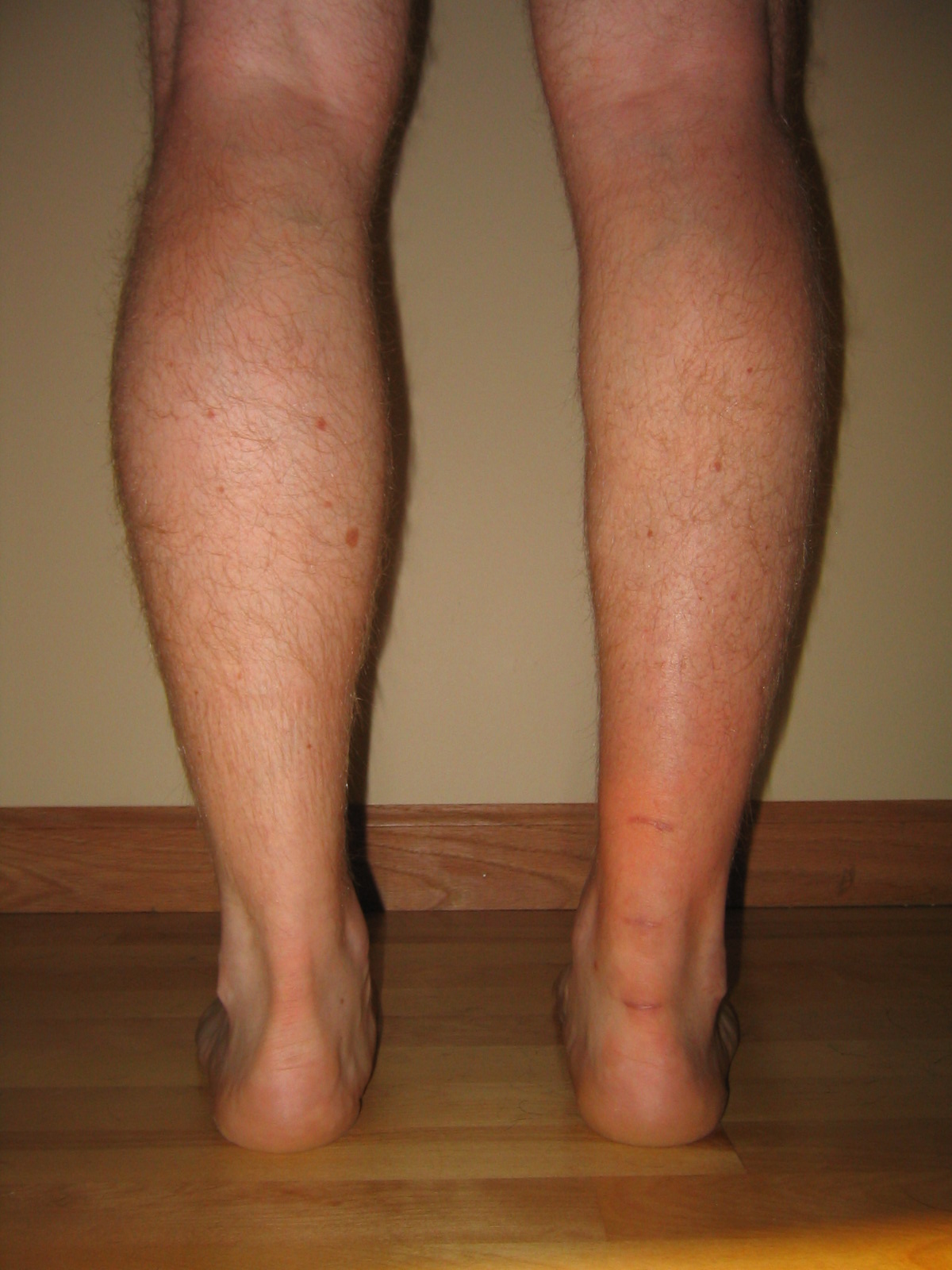
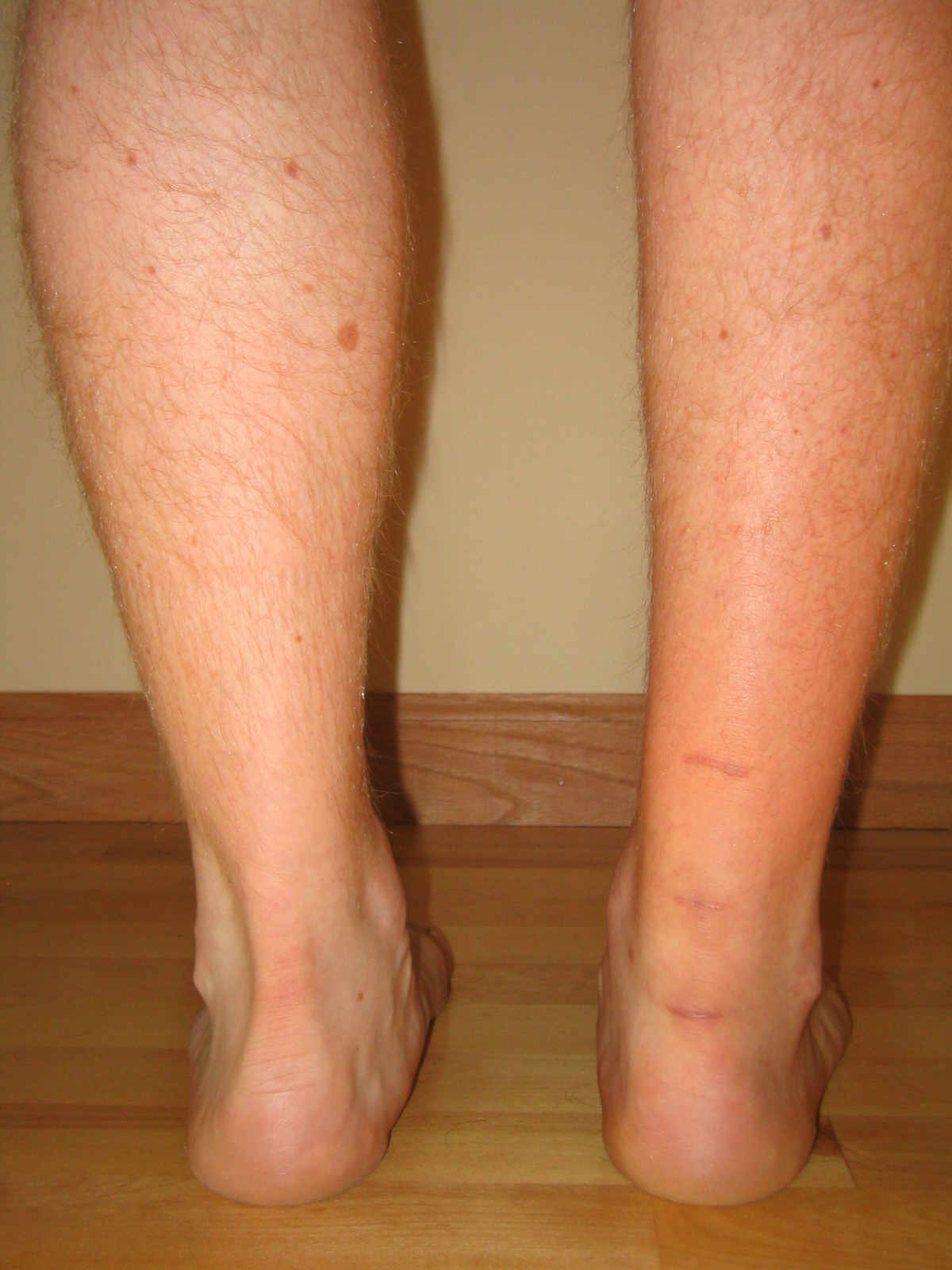
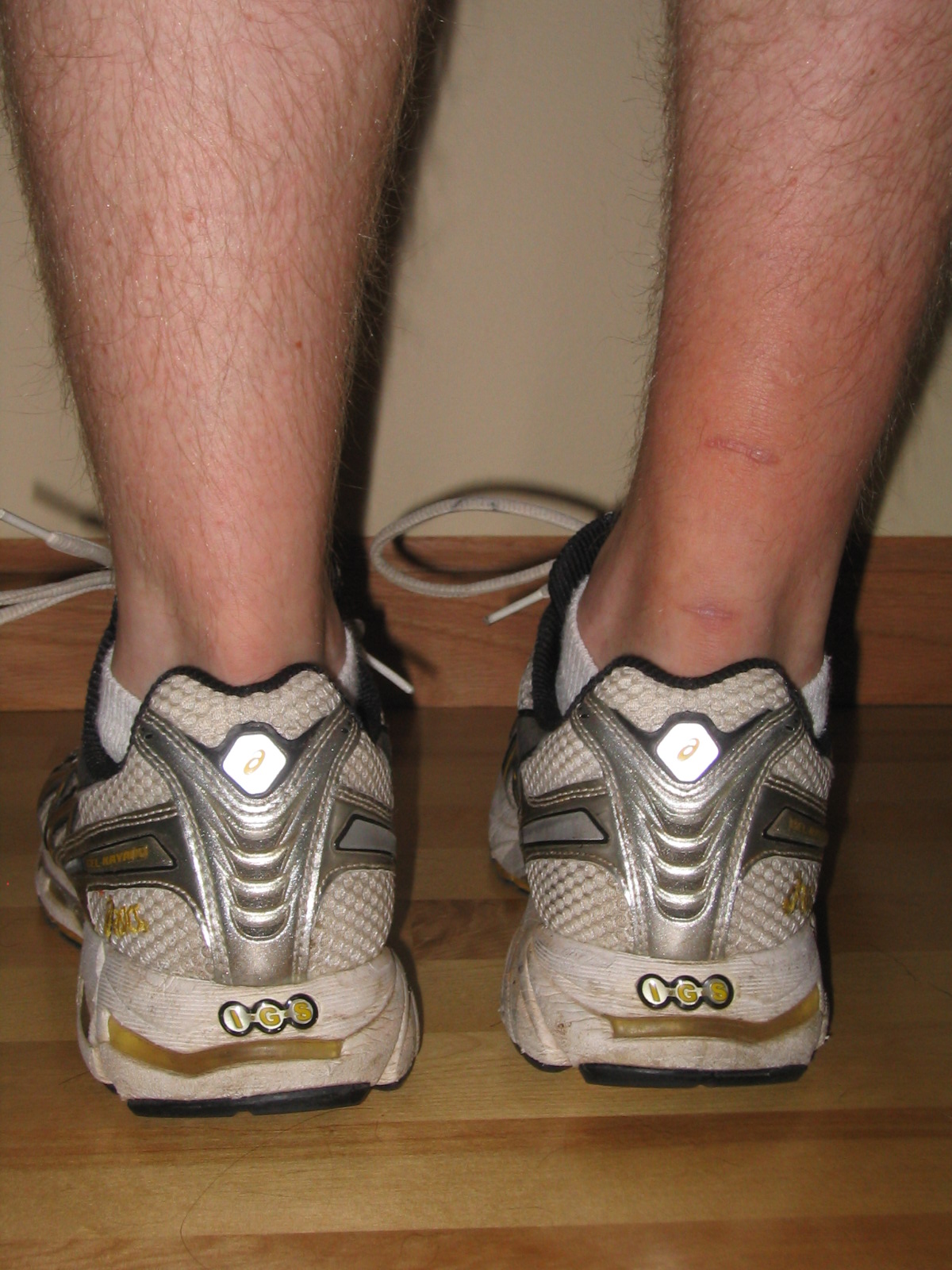
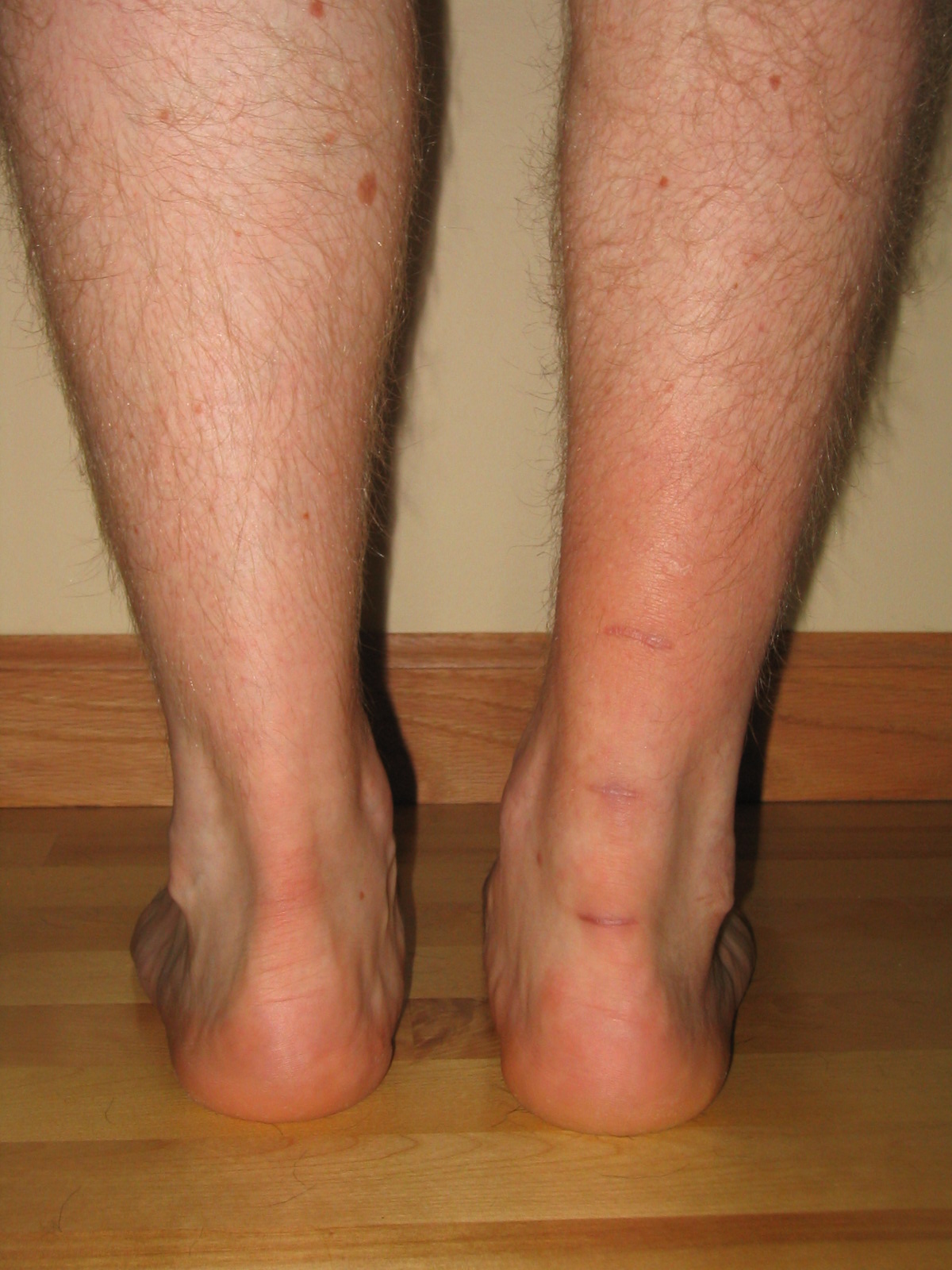
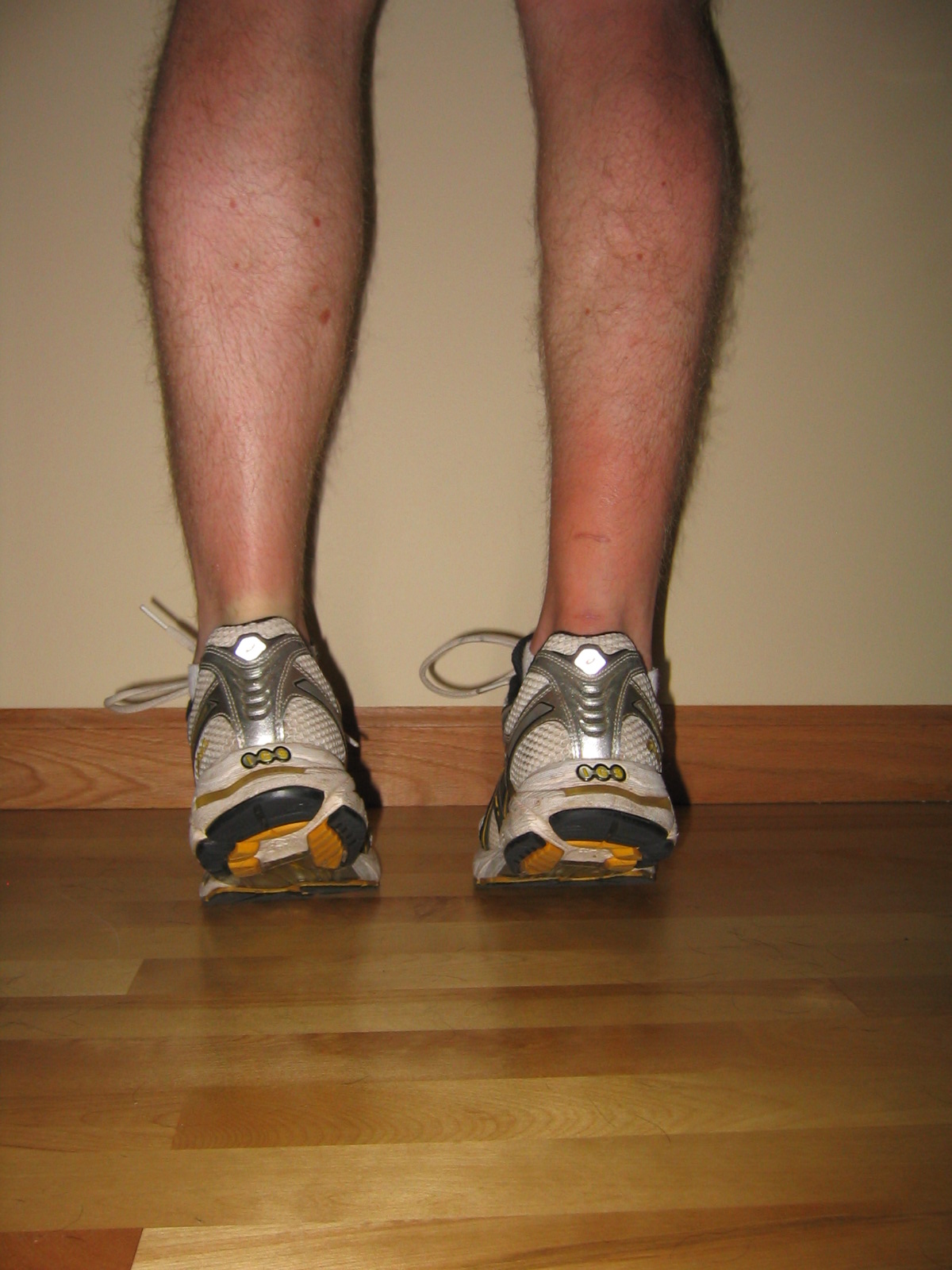
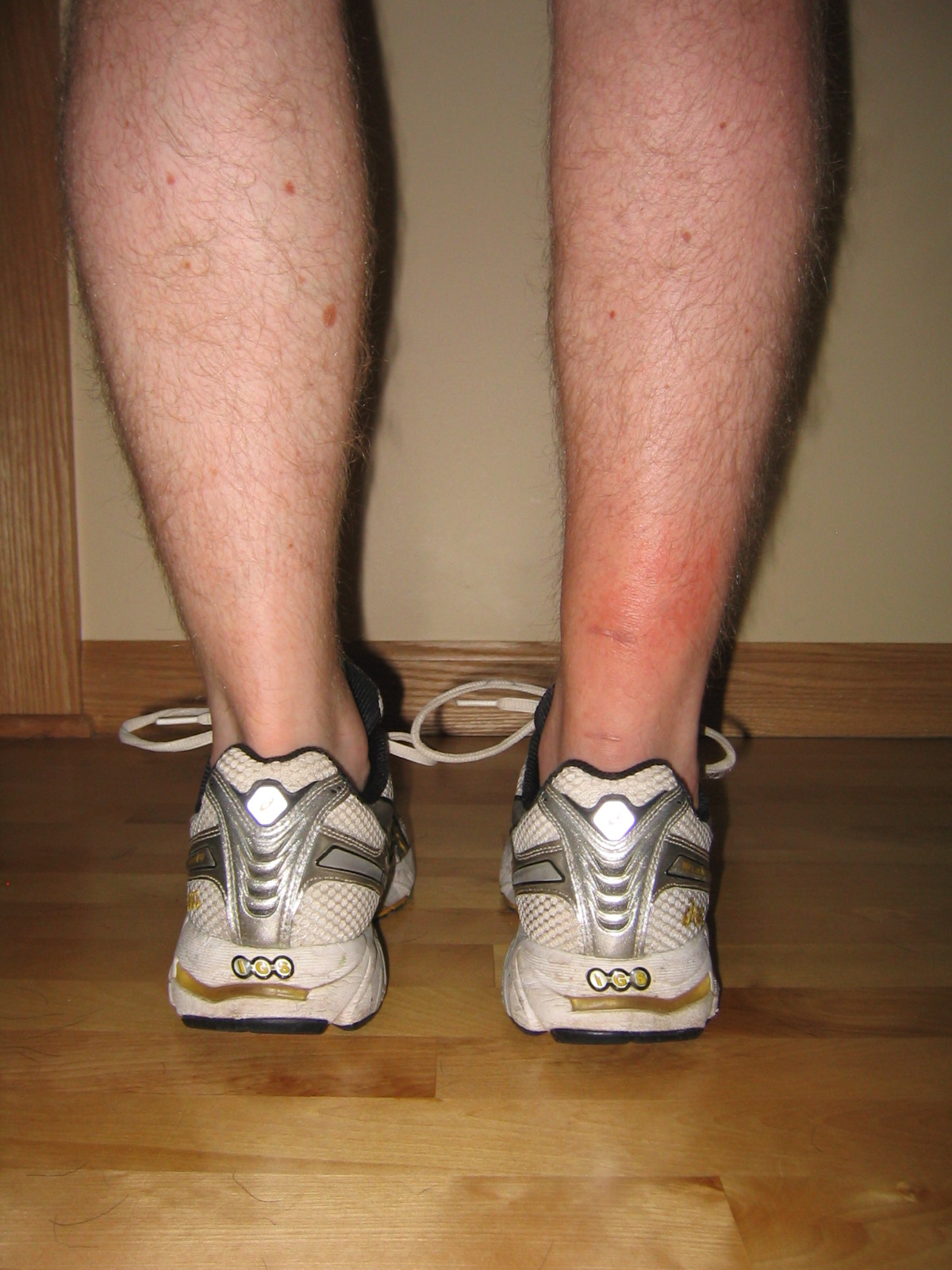
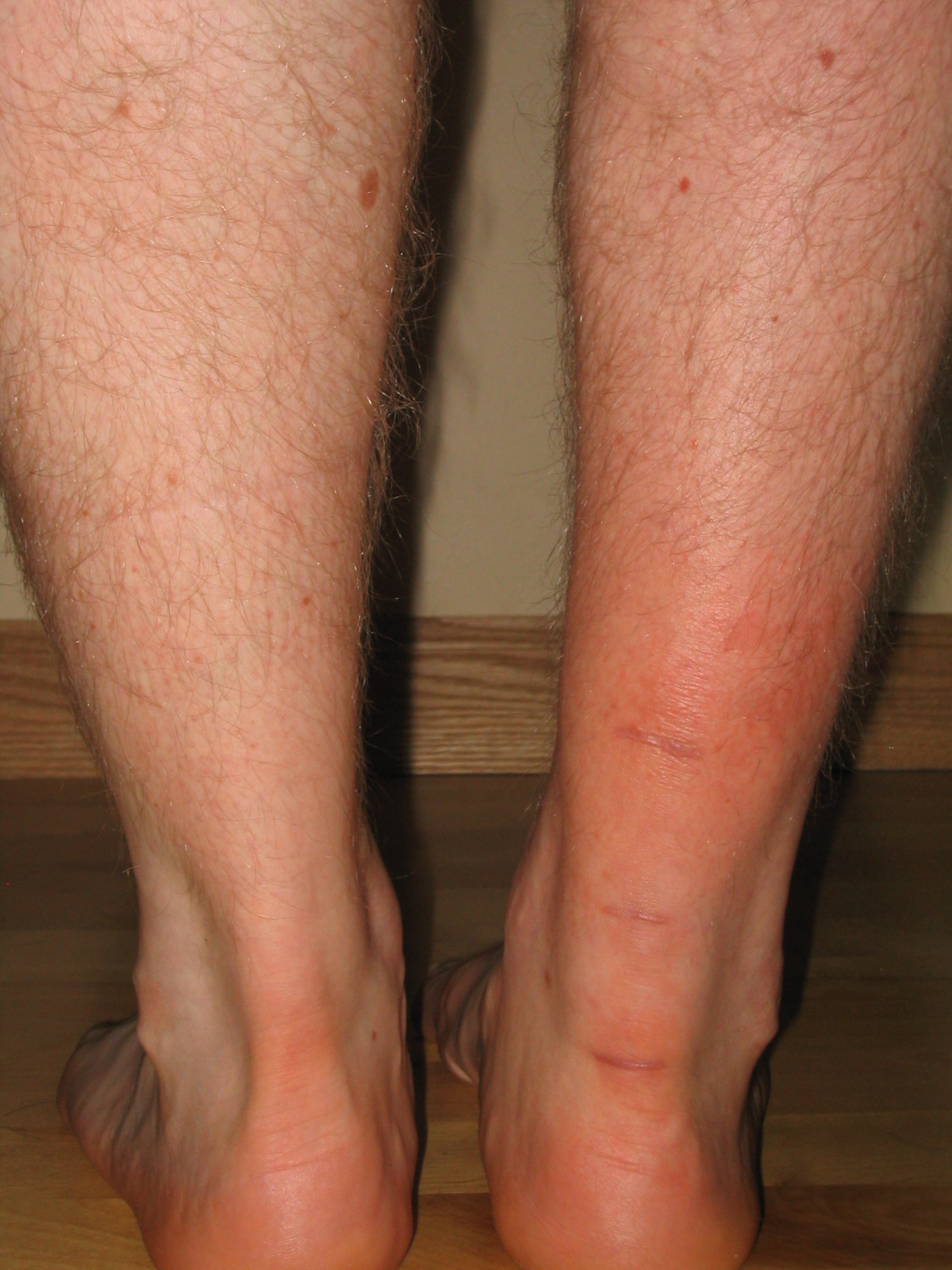
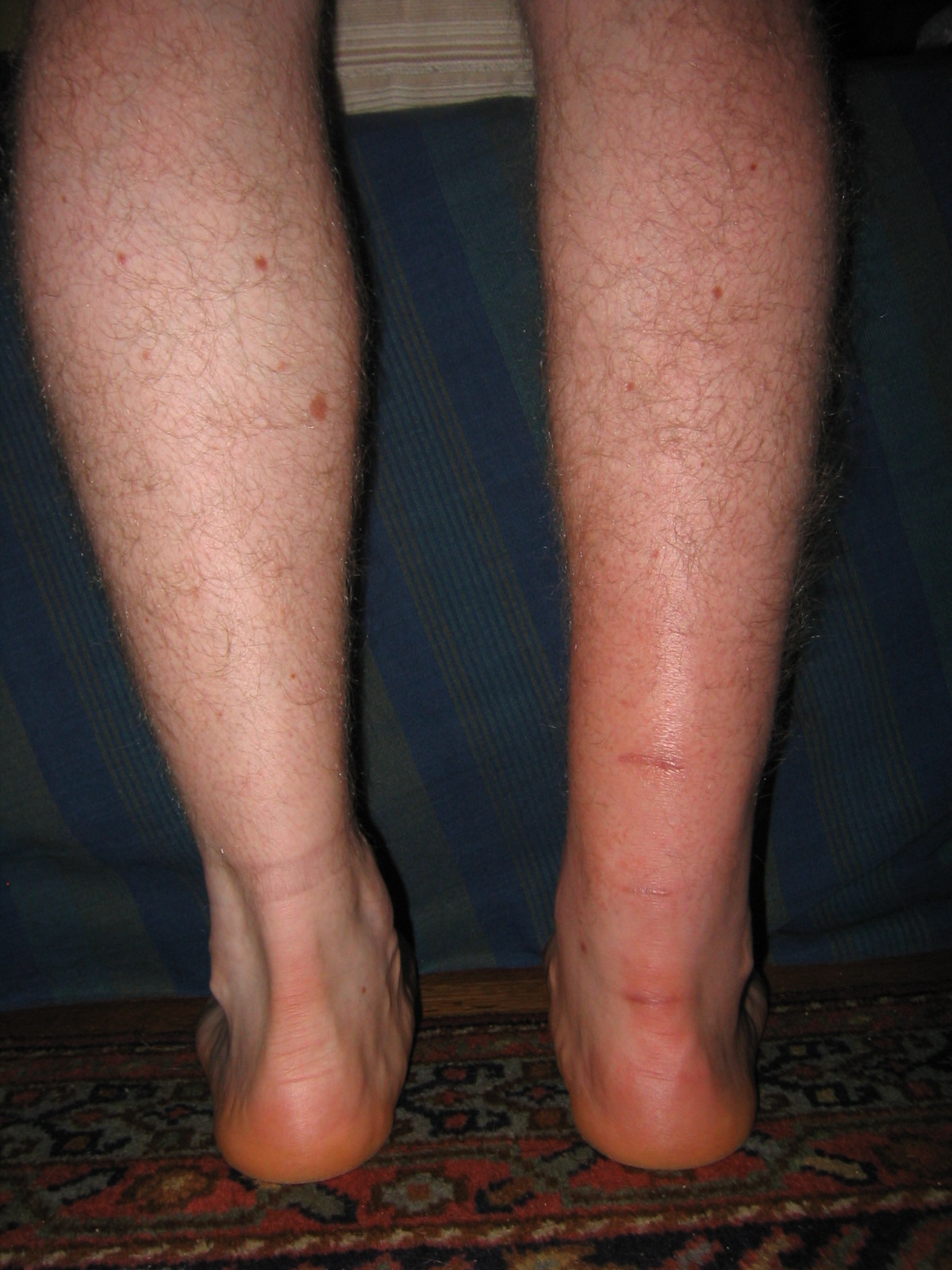
Today I am officially one year post-op, enjoying the celebration at the finish line in Central Park on the virtual marathon tracker.  I also thought it was an appropriate day to wear my Achillesblog T-shirt.  While I’m very happy to be at this point, I know I still have some work left to be done.  I guess I can say that I’m fully healed, but maybe not fully recovered.  What I mean is that the AT feels healthy and strong (the icy sidewalks this winter have been a good test!), but calf strength continues to be a challenge.   The progress is still slow even though I’m consistently getting to the gym 4-5 times a week.  I change up my routine pretty frequently to try different exercises and lifting philosophies, but at this point I’m pretty confident that I just need to remain patient and diligent.

The lagging strength doesn’t affect any of my daily activities and generally goes unnoticed unless I’m exercising.  I notice it most with single leg heel raises. I’m only able to get a minimal amount of clearance under my heel and am not able to hold my weight for very long.  I also notice the strength when I’m running.  My right leg just isn’t as strong and my gait not as fluid as prior to the injury.  I tend to cup my foot a bit when toeing off, what I assume is a compensation for the decreased calf strength.

So, I plan to continue visiting the gym regularly throughout the winter months in hopes that my pre-injury calf strength and gait will return.  I have several half marathons planned for the spring and summer along with a full marathon in the fall.  After missing running outdoors most of last year, I’m definitely feeling the need to get back out on some of my regular trails.  Unfortunately, the cold and snowy winter has kept me inside on the treadmill and indoor track. 

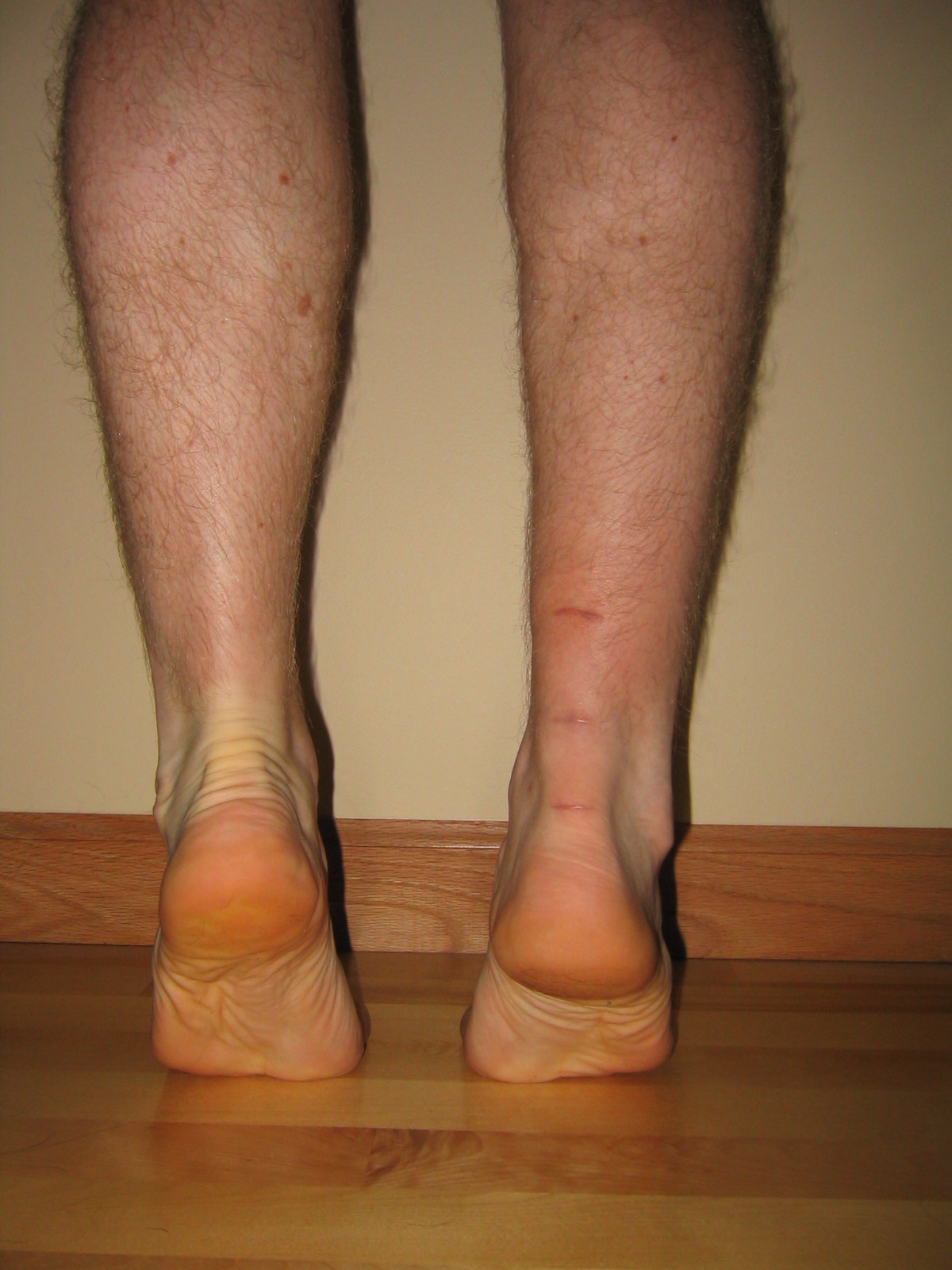
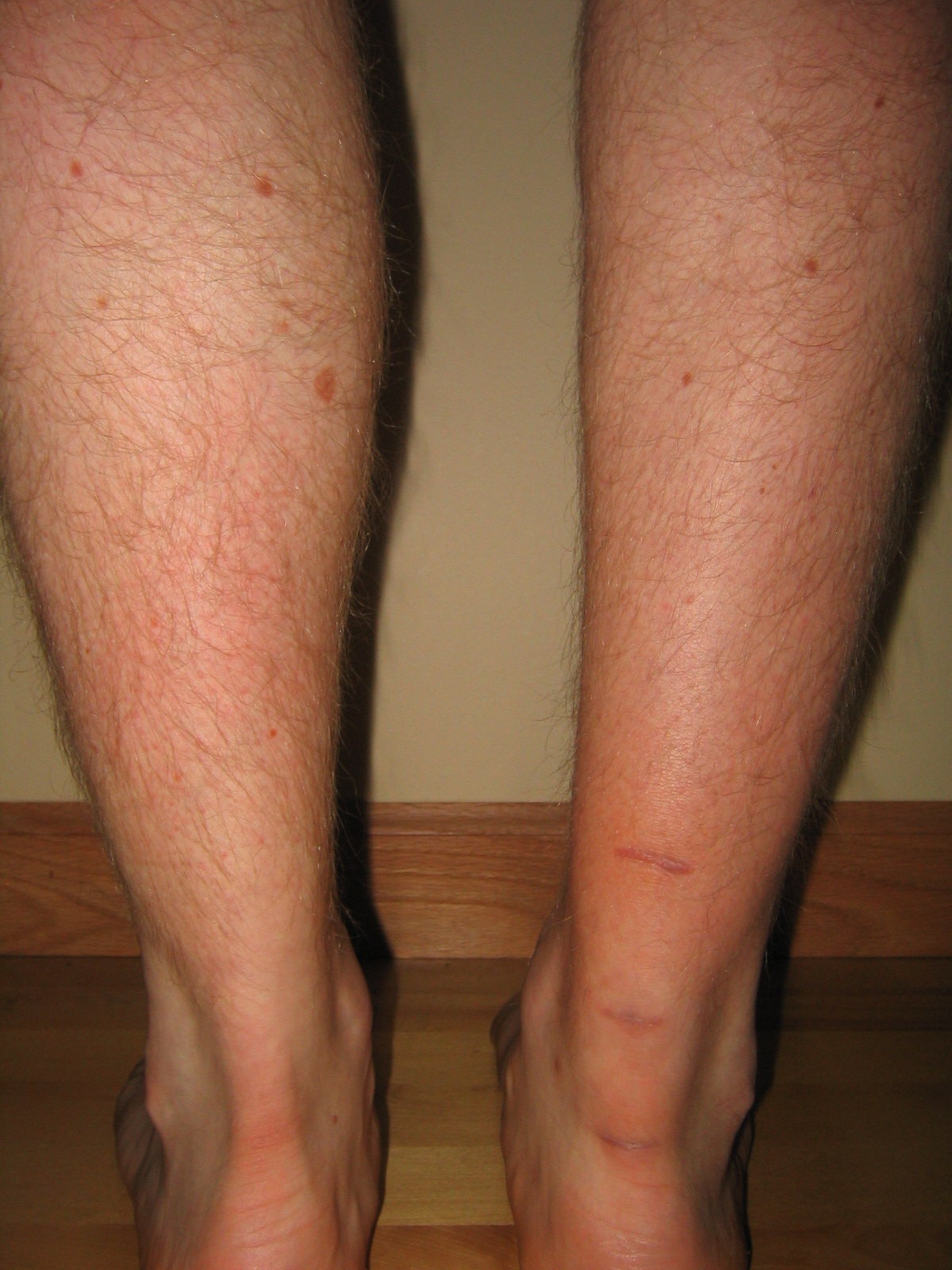
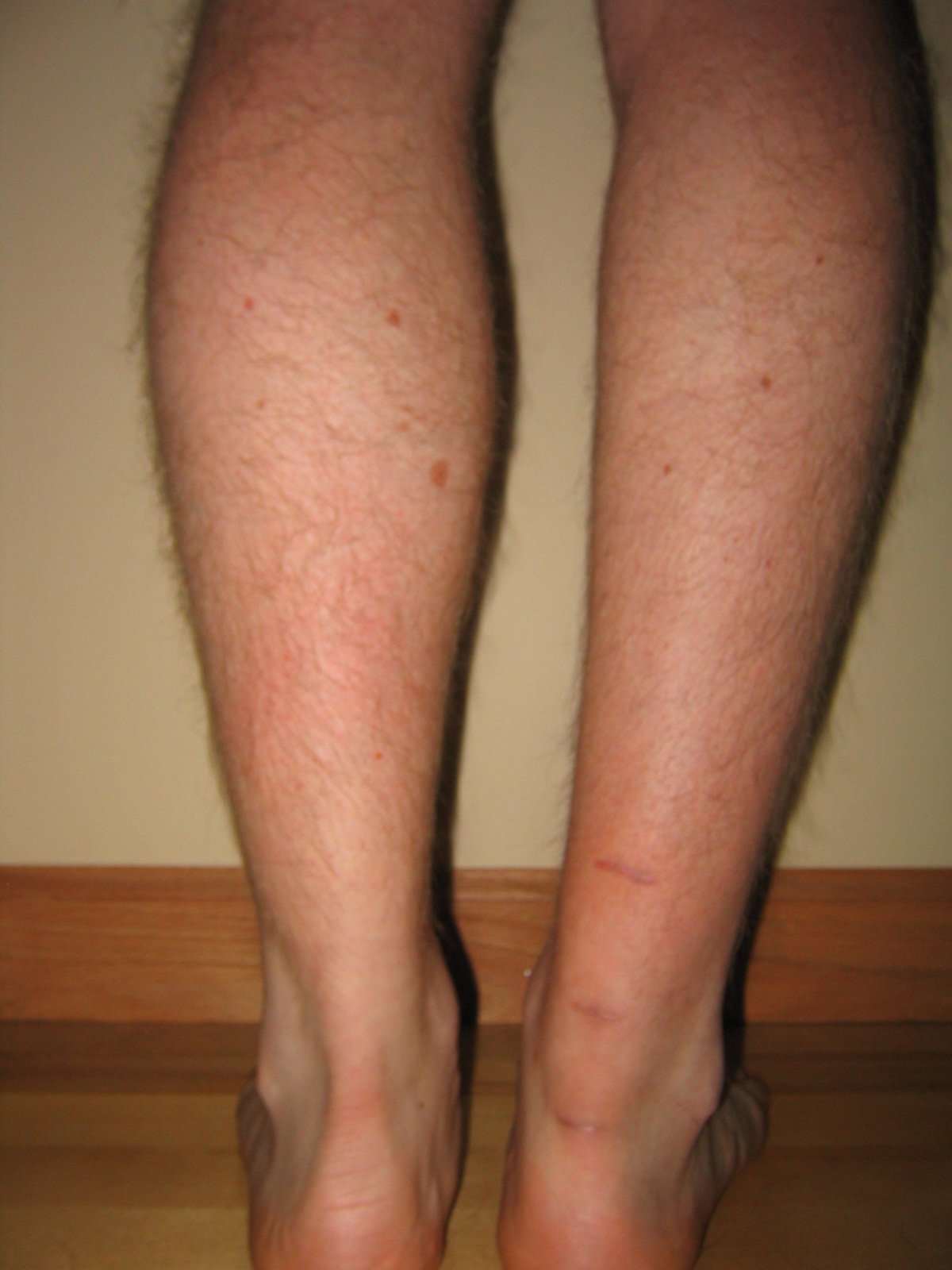
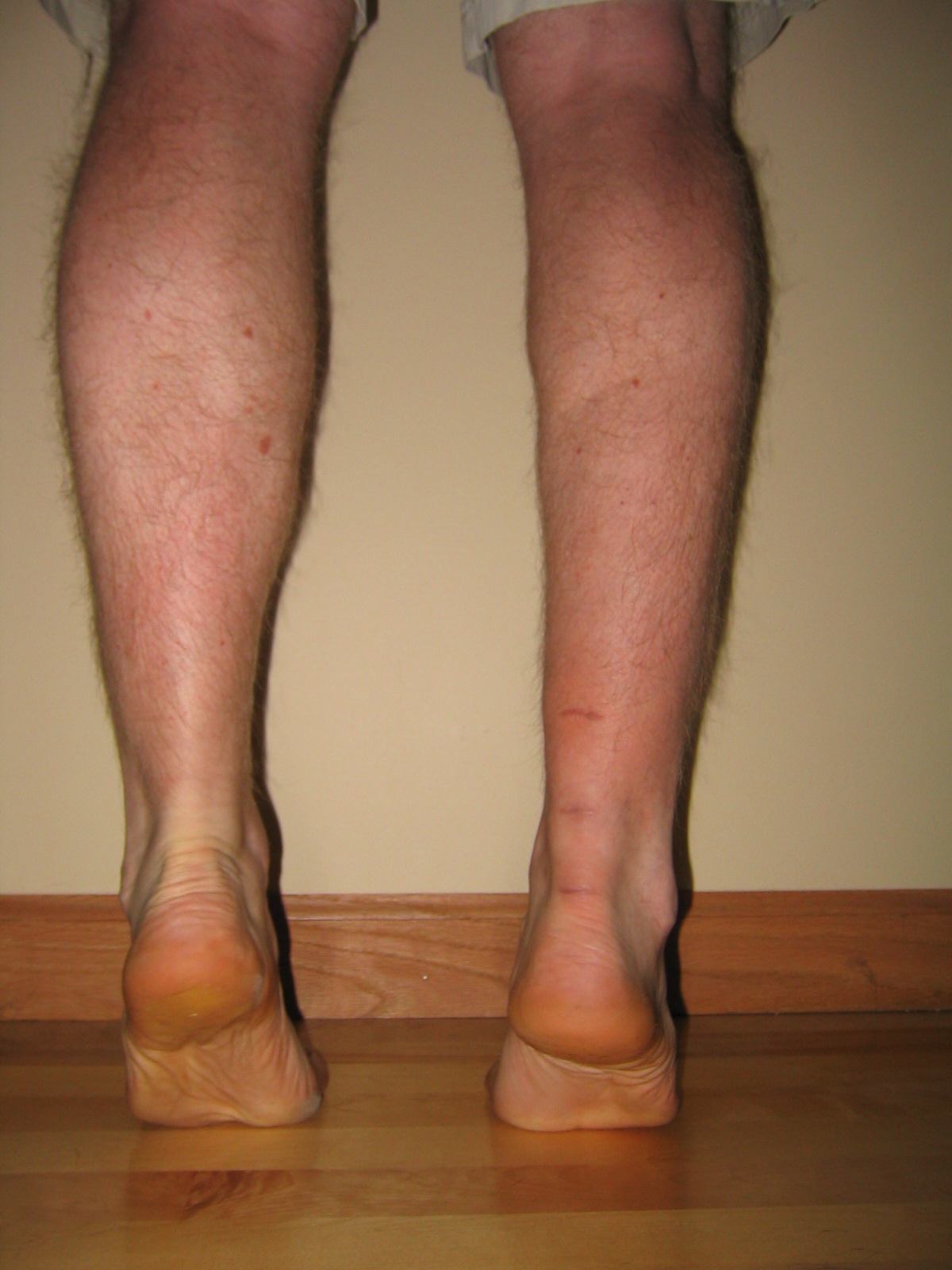
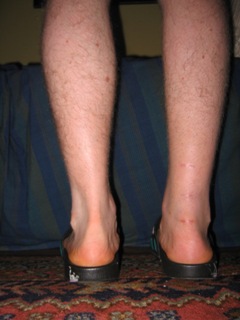
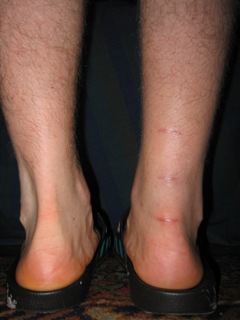
Well, now that I’ve hit my one year anniversary and made it to the virtual marathon finish line, I’m not sure how often I’ll update the blog, if at all.  But, I know I’ll continue to check Achillesblog.com for the foreseeable future to track the progress of all my new cyber friends.  It’s great to see that so many are healing very well.  I’ll also continue to respond as best as possible to any questions raised by others in the comments below.  With that, I’ll close by posting a few pictures of my Achilles and calf at 12 months post-op.


Month 11 Update - Nice Calf!

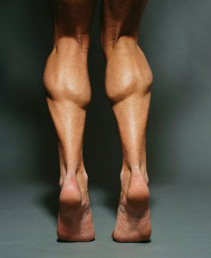
Well, as you can see, I made some major gains with my calf muscle this past month. Okay, I’m only joking. Just had to see if anyone’s still following along. Perhaps with all the hard work my calves may one day look like this, but for now they’re still the same chicken legs I’ve shown off for the last months. I decided not to include my actual calf photo in this month’s post, but there is a new picture in the photo chronology on the left sidebar.

I’m a few days tardy with posting my monthly update.  But, at this stage, a few days here or there doesn’t really matter much.  I continue to see some progress, albeit slowly. The calf strength is returning, but it is still well below my pre-injury level. Nagging injuries (back strain and ingrown toenail) slowed me a bit this month, but I’m still trying to do as much as I can.  A single leg heal raise is still difficult as I’m able to only momentarily press my heel off the ground before my calf gives way. My agility is improving as I’m able to hop around on the injured leg a bit better, but I’m not able to hold my weight up on the toes.

We got several inches of snow the last couple of weeks and I was getting excited to pull out the skinny skis for the season. I haven’t been out skiing since the injury occurred last January.  But, a mild weekend and a rain shower this morning has turned the snow to mush. I’m sure I won’t have to wait too long before we get some fresh snow.  X-country skiing gives me a pretty good workout and perhaps it’s the motion that will put some spring back into my calf.

I’m nearing the last couple of miles on the marathon tracker, and while the finish line is slowly coming into view, I know there is still a lot of work left to be done.  So, until my one year anniversary next month, happy healing to all!

10 Month Update

Things are starting to come full circle.  It was a frigid January evening when I ruptured my Achilles tendon.  Now, 10 months later, the Minnesota temperatures are starting to plummet again and the snow flurries are flying.  It’s hard to believe how fast the time has gone by.  I’ve now seen 4 seasons post-ATR.  While a portion of this past year was lost, it’s nice to look back and realize what a blip on the radar this time period has been.

I don’t have too much progress to report, but I’ve been trying to post a monthly update.  The repaired tendon still feels good and the calf strength is slowly returning.  I’m getting more and more comfortable increasing my activity level.  Running is progressing well although my stride is not quite back to normal, the main difference being the reduced strength of the injured leg.  I’m still a bit slower than before the injury, but I’m confident the speed will return.  I hope to start trying some plyometric exercises in the upcoming months in an attempt to regain some speed as well as explosive strength.

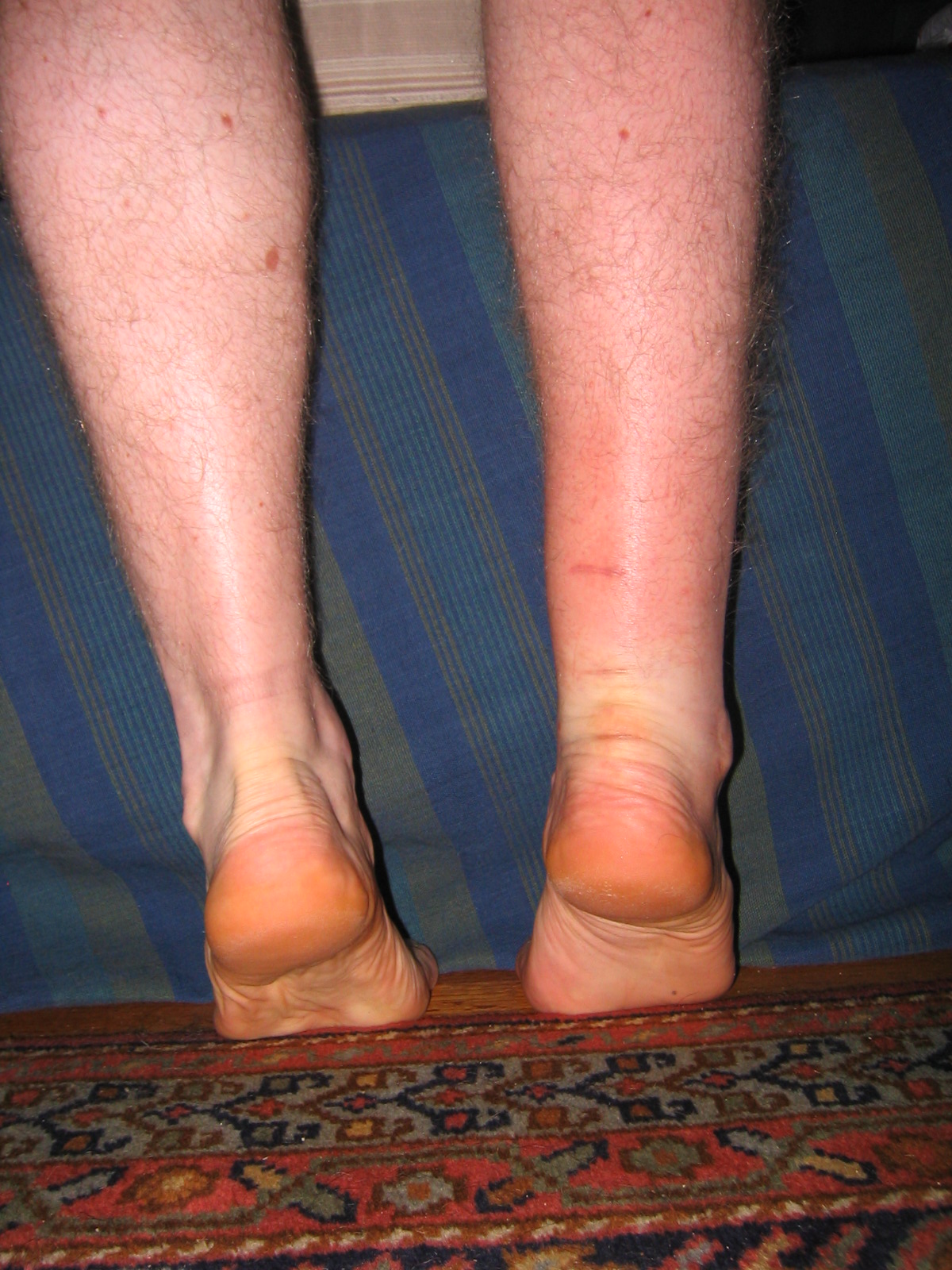
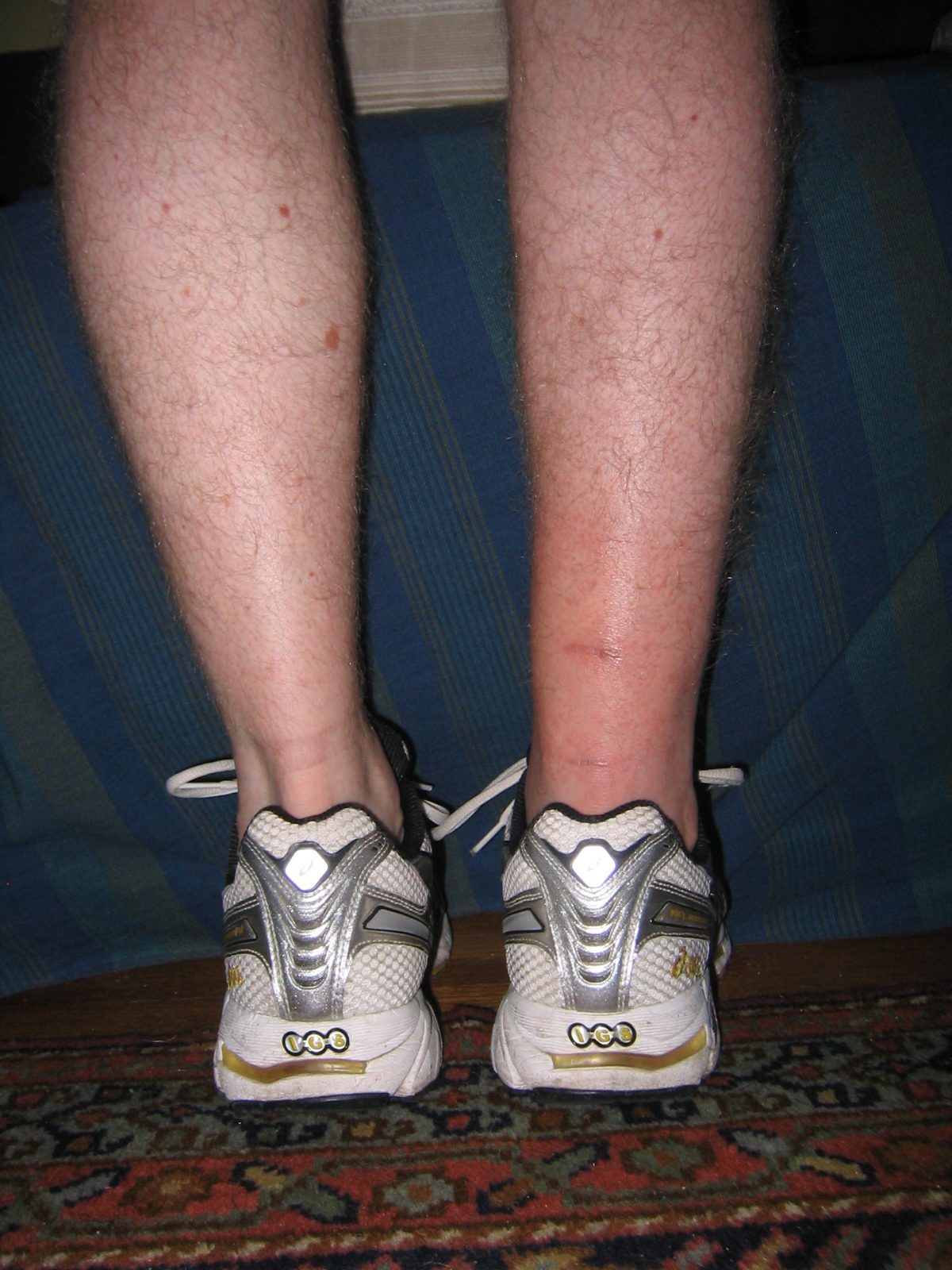
I’ve attached a few photos below.  You can probably see the muscle mass is still slow to return , most notably on the medial side.  But, I can feel a big difference from several months ago.

Still Feeling Fine at Month 9

9 months have past since my Achilles rupture and subsequent surgery. Three quarters complete, assuming a 12 month recovery. The tendon is doing great and I’m progressing along pretty well at this point. I’m still trying to regain the strength in my atrophied calf which has been quite a battle. Some muscle mass has returned, but I don’t have much power when trying to push off from my toes. This may be more of a mental issue, trying to get all the muscles to fire at the right time. Here are a few pictures to document my progress to date, not too much different from last month’s photos:

I just noticed I passed the 20 mile marker on the Marathon Tracker widget. I’m now in The Bronx just in time to say goodbye to Yankee Stadium!! The marathon metaphor was born early in Achillesblog development by several of the “old guard” and has been used over and over again. Speaking from my experience, it is true that the recovery is a marathon, not a sprint and requires overcoming both mental and physical anguish. However, there’s one area where I’m hoping ATR recovery differs greatly from running a marathon. It is commonly said that the last six miles are the second half of the marathon, requiring as much physical grit and mental determination as the first 20 miles. I don’t believe the final six miles of this virtual marathon called ATR recovery will be as difficult as the final six miles of an actual marathon. I’m getting stronger and stronger and I’m looking forward to cruising across the finish line 3 months from now.

Hang in there everyone. While this isn’t a marathon any of us want to be running, it is one that we will all finish.

Month 8 and Feeling Great

Eight months ago I was sitting on the couch, foot propped up, searching the internet for advice on surviving an Achilles tendon rupture.  I had just returned from surgery on my ruptured tendon and I knew I was in for a long recovery.  Well, today I look back and realized how far I’ve come.  I still have my foot propped up, but that’s because I’m relaxing after taking a short run through the neighborhood.  Not sure that I’ve learned how to survive an ATR, but I found a great blog community along the way.  And, I’m feeling that much closer to “normal”.

The above pictures illustrate the latest progress.  Actually, the photos don’t show much, but I feel like the last month has been pretty productive.  I had been dealing with inflammation around the tendon for a few months, but it feels like that has now mostly subsided.  I had to limit my strengthening and running as a result of the inflammation.  However, now after several months of focusing mainly on dynamic balancing exercises, I’m finally able to start some more aggressive strengthening exercises again.  I’ve also  gradually started to run again.

The tendon itself feels great.  The discomfort from the inflammation is gone.  I have complete confidence with the strength of the repair and no fear of re-rupture at this point.  My current struggle is rebuilding the calf muscle.  It has been a slow process, but I’ve never been quick to add muscle mass.  I’m able to get a bit of clearance on a single leg heel lift, but not enough to really claim victory.

When the injury happened and I considered the 6-12 month recovery process, I always figured I’d be back to normal in 6 months.  Not sure if that was my optamistic mind or the competitor in me.  So, I was a bit frustrated when 6 months pasted and I wasn’t back to normal.  It was about this time that I started to realize how true it is that everyone heals differently.  It’s been interesting to hear a few of the other Achillesblog vets make similar comments.  We all want to be back to normal as quick as possible, but we have to accept that our biological makeup plays a significant roll in the speed of recovery.  There are small things we can do to assist with our recovery, but there are no real shortcuts.  While I would’ve preferred to be back to normal at 6 months, I’m still very encouraged that I have another 4 months left before the end of the typical recovery window.  4 months is a long time to get my calf close to my pre-injury strength.

Seven Months - Emerging from the Abyss

Last Saturday marked the seven month anniversary of my surgery.  I’ve been vacationing for the last week, and haven’t had a chance to publish any new posts lately, or read and comment on other’s blogs.  I have to admit it’s pretty overwhelming checking out Achillesblog.com after stepping away for several days.  So many new names, but it seems like the stories are pretty similar.  I did have a chance to read through some of the  posts from the old achilles vets and it’s good to hear that everyone seems to be progressing well.

So how am I progressing?  All in all, pretty good.  Here are a few photos to document the seventh month mark:

There have been a few changes since my 6 month update.  I went to see a new physical therapist right before I left for vacation.  I was getting a little impatient with my progress and thought a new PT might have some additional insight into my healing.  My insurance is also dropping my old PT clinic from its network, so that added to the need for finding a new clinic.  I’ve had only one session, but I’m glad I made the switch.  My new PT seems a bit more engaged with my healing and definitely has more experience with the injury.  He’s also a bit more hands on and wants to try some different techniques to thin out the pesky scar tissue.  I’m not expecting any miracles as I know part of rehabbing is just patience and time, but I feel the new PT may help tip the scales and push me out of the abyss.

I believe I’ve been dealing with inflammation for the last several months which has limited my progress.  It bothers me with some exercises (including heel raises) and has caused a minor amount of discomfort with just about every step I take.  The new PT even commented that he could feel the heat radiating from the tendon area and that was while I was just at laying at rest.  He advised I use the heat as a guide while rehabbing.  If the area starts to feel warm, then back off from that exercise.

I took a short hiatus from the gym while I was on vacation and gave my tendon a bit of a break.  I continued with several of the basic PT exercises while away, along with a bit of swimming and several hikes, but nothing that was too strenuous.  My tendon felt really good when I returned to the gym this morning.  Perhaps a bit of a layoff helped??

The limp is basically gone although it does show up briefly in the morning and when I try to walk fast.  The scar tissue is thinning out a bit, although there is still a bit of a bump above the rupture location and the whole tendon is still much thicker.  I can’t quite do a proper single leg heel raise.  I believe Brendan talked in his last post about being able to get the heel off the ground with a bent knee, but not with the knee locked.  That’s basically where I’m at as well.  I’ve backed off from running for the time being, hoping that might also help with the inflammation.  I still bike to keep up my cardio level.

This morning I received probably the nicest complement since the injury occurred.  There is a very nice woman who works the check-in desk at the gym, greeting members and swiping IDs.  Today she asked how my leg was doing.  Now, we’ve had some short conversations in the past, but the injury never came up.  So, a little surprised she asked, I gave her the canned answer of, “It feels pretty good.”  She responded saying, “I can tell, you’re getting around so much better.”  I’ve felt for several weeks now that I was getting around pretty good, but it really made my day to hear confirmation from an indepedant source.  I’m sure she sees hundreds of people coming into the gym everyday, so the fact that she noticed and was impressed with my improvement over the last several months really meant a lot.  It made it feel like the hard work was starting to pay off.

We’re Not Alone

Even some professional athletes find out that ATR recovery can be frustrating. Here is an article about the Denver Bronco’s Ebenezer Ekuban, who ruptured his Achilles last August. You’ll read some quotes within the article that may sound very similar to comments left on achillesblog.com. 

Here’s a second article with a few additional comments from Ekuban.

I hope nobody feels discouraged from reading these articles.  My purpose for posting these is to show that even professional athletes can feel frustrated at times during recovery.  And, they’re likely receiving the best treatment available.  So, try not to let slow progress get you down.  You’re not alone.  And, don’t forget to celebrate all the milestones during recovery, no matter how small they may seem.

Antibiotics Poll

The topic of a link between antibiotic use and tendon ruptures has come up numerous times in the last few months.  Most recently, as daveleft pointed out, the FDA has ordered makers of fluoroquinolone drugs — a potent class of antibiotics — to add a ‘black box‘ warning to their products, which include Cipro, Levaquin, Floxin and other medications.

I thought I’d change the poll on my blog to again pose the antibiotic use question.  I know a lot of people have already commented about antibiotic use prior to their ruptures, but I thought it would be helpful to see the results in a poll.  So, feel free to click “yes” or “no” on the poll in the left sidebar.

It may be interesting to see what affect the FDA ruling has in the future.  Will doctors prescribe these antibiotics less frequently?  Are there other antibiotics that will successfully ward off infections in all situations?  Unfortunately, unless you’ve had a ruptured tendon or chronic tendinitis, a patient is unlikely to question the affects of an antibiotic prescribed by the doctor.  At that point we just want to take something to cure the infection.  Will the FDA’s ruling reduce the growing number of Achilles tendon ruptures?

As for the previous poll, it was quite encouraging to see that so many people plan to stay involved in sports and activities when they recover.  To refresh your memory, the previous poll asked, “Assuming a full recovery, do you plan to compete in all the sports and activities that you did prior to the injury?”  Here are the latest percentages based on the 40 votes:

I’ll be back as soon as possible.  38% 15
I’ll avoid the activity in which I suffered the rupture, but I’ll stay involved with sports.  30% 12
I’ll only participate in low impact activities.  23% 9
I’ve retired to the couch from here on out.  3% 1
Undecided.  8% 3

I thought that other factors such as age, family, job, previous injuries, etc. would result in more people deciding to “retire to the couch”.  It’s great to hear that a majority of those who voted will continue to stay active.  I was a little surprised to see that 30% will remain active, but will avoid the activity which resulted in the injury.  I’m sure this is in part due to some of the ruptures occurring during activities we don’t normally do, but the percentage was still a little higher than I expected.  Of course, the small sample size can also skew the percentages pretty easily.

So, what ever you decide to do in the future, here’s to a complete recovery!

Half Way Home

Well, here I stand at the half way point on the marathon tracker.  Brooklyn is in my rear view mirror and Queens is just a few steps ahead.  That’s right, Wednesday marks the 6 month anniversary of my Achilles surgery.  I remember thinking shortly after the injury occurred back in January that July seemed so far away.  My how time flies!  While there’s still another “half marathon” to go, I anticipate the road may start to get a bit smoother.

Here are a few photos to show the latest progress:

For the newer members, my surgeon uses a slightly less invasive procedure that includes 3 small horizontal incisions as opposed to the longer vertical incision.  Here is a link that closely describes the procedure.

After spinning my wheels for several months, I feel like I’ve made more progress this month.  Although I still don’t have a lot of strength in my calf, I can see and feel quite a bit more muscle mass.  The persistent limp has diminished significantly, although not completely.  I still limp slightly first thing in the morning, late in the evening, when walking fast and when walking barefoot.  There is still some swelling around the ankle, but it looks better than it has the last several months.  Also, as you can probably see in the photos, I still have a bit of a scar tissue mass by the top incision.  I still get some pain in the tendon and lower calf when I push things a little too hard.  I use this as my guide for taking a break.  My PT advised that a little pain can be expected while recovering.  If the pain gets worse, it’s a sign to dial things back.

Although I’m sure my latest progress is mainly the result of time and patience, I have tried a few things that may be helping.  First, I’m working more rest days into my workout schedule.  This has been mentally challenging because I don’t want to look back a year from now and wonder if I should have been doing more after the injury to rebuild the muscle strength.  Second, I’ve been wearing a compression sock for awhile which seems to help some with the swelling.  Third, I take an occasional dose of ibuprofen and fish oil to try and minimize any inflammation around the tendon.  Like I said, I don’t know if any of the above are having an affect or if the latest progress is just the result of time, but for now I’ll continue with what seems to be working.

So, what’s next?  I’ll continue my work at the gym trying to regain the lost calf muscle.  I also intent to start uping my running milage.  I’m hopeful that I’ll be able to comfortably run a 5K by the end of the month.  I’m going to PT every 2 weeks now, mainly to get a good massage and to check my progress with several of the exercises.  My hope for the next month is that the limp will be completely gone and I’ll be doing unassisted single-legged calf raises.  Here’s to the second half!

Cheers!

Response to Tennisfreak’s Question

Tennisfreak recently posted the “why did this injury happen” question on his site.  I knew my response would be lengthy, so I thought I’d write a separate post with my answer.  

I think I gave the “bad luck” response to this question earlier, but I thought I would explain myself a little further.  I’ll preface all of what I’m saying by pointing out that I’m not doctor, I’ve just done some research and have had a lot of time to think about this injury.  IMO, genetics and abuse play a large roll in AT injuries.  Tendons are composed of a couple different collagen fibers, mainly type I and type III.  I believe type I can be more flexible that type III, and some people can produce more of one type of collagen than another.  Therefore, genetics may put some people at a higher risk for a tendon injury. 

However, genetics alone won’t necessarily cause a rupture.  Studies show that around 80% of AT injuries occur in active people or while being active.  Active people put more strain on joints and tendons which can lead to injury.  Again, being active doesn’t equate to injury, but it can be a contributing factor.  Years of abuse may increase the risk.

Here is an abstract for a study which concluded that ruptured ATs produced more type III collagen.  Essentially, type III collagen may be produced to treat microtraumas created when we put stress on our tendons, thereby compromising the strength and flexibility of the tendon.

Another way to think about an AT injury is the rubber band example.  A rubber band can be very strong.  But, if you continually pull on the ends of the rubber band, you will notice that it starts to lose its strength and shape.  This is equivalent to the strain that many of us have placed on our tendons over the years.  Keep stretching it enough or give it one really long stretch and it will eventually snap.

So, when I say “bad luck”, I mean that there are circumstances that may be beyond our control.  We cannot change our genetics or the collagen our bodies produce unless science comes up with a method.  We could just give up being active which may reduce the risk of a rupture.  But, if the conditions are right, the rupture could occur stepping off a curb.   Personally, I would rather have a rupture occur as the result of playing basketball or volleyball or softball rather than stepping off a curb.  Plus, reducing our activity level could lead to other more serious heath issues such as heart disease. 

That being said, I’m sure there are ways to reduce the risk of a rupture occurring.  Maybe we need to work stretching specific workouts or yoga into our routines.  Maybe we need to focus on our footwear.  Perhaps the correct orthotics could prevent a rupture.  Maybe diet is a factor.  I’m sure there are many other variables that may play a roll.  But, I’m pretty sure no one has come up with the magic formula to eliminate ruptures.  That is why there have been almost 100 members blogging on achillesblog.com since February.

Poll Update

I thought I’d change the poll on the blog, but I wanted to summarize the results of the previous poll.  To refresh, I asked if you experienced any pain or tendonitis/nosis prior rupturing the Achilles tendon.  Here are the results:

59% - “Never knew what an Achilles tendon was until it ruptured
22% - “
Experienced tendonitis/nosis for several years”
20% - “Had some pain in the Achilles prior to the rupture”

I’m assuming the 59% also includes people who didn’t experience any pain prior to the rupture.  I meant to include that as a separate option, but forgot.  Not much to conclude from the mixed results and small sample size (41 votes).  Like so many things about this injury, it’s a mixed bag of nuts.

On to the new poll.  This topic has come up repeatedly, so I thought it might be fun to poll the results.  The question is, “Assuming a full recovery, do you plan to compete in all the sports and activities that you did prior to the injury?”  Feel free to log your vote on the poll in the left sidebar of the page.  Also, you can leave a comment to share what you plan to do after recovery.

As for me, I plan to resume all of my activities when my body is ready.  Athletics play a huge roll in who I am as a person.  While this injury is severe, I know that a full recovery is possible.  Suffering through a 6-12 month recovery is far less painful for me than to give up any of the activities I love.  As Doc Ross so eloquently said, “You only live once, you can sit on the bench or you can get in the game.” 

Obviously, we all have different circumstances.  Age, family, job, previous injuries all play a part in the decision to resume playing the games we all love.  So, I completely understand the decision to avoid stepping back on the court/field.  I’d love to hear what factors will influence your decision.

5 Months, The Healing Roller Coaster

Monday marked the 5 month anniversary of my January 9th operation.  Things have been pretty busy at work lately so I haven’t had as much time to post or comment.  I finally had a chance today to catch up on some of the latest blog posts, and it was funny to read people mention some of the exact same things that I was thinking about including in this post.

I believe it was Withnail who mentioned the roller coaster metaphor.  That is exactly how I was going to describe this past month of recovery.  I have days where I’m making progress, chuggin’ up the hill, only to have the bottom drop out.  It then seems like I go through several days of feeling like I’ve taking a big step backwards.  The limp still lingers and unilateral heel lifts still seem several weeks away.  I’m really starting to appreciate why this injury is described with a 6-12 month recovery.

But, all is not sour. I’m trying not to be discouraged by what seems like a lack of progress.  I look back on the days when every step was an adventure and am thankful to be fully mobile once again.  It wasn’t that long ago that jogging, squatting, and lunging were distant aspirations.  And now I’m able to do all those things, generally with little to no pain or discomfort.  While the progress is slower than it was the first few weeks sans boot, it is happening.  It just isn’t as obvious and cannot be compared day by day.  I believe Dennis mentioned this same thing in a recent post.

Attached below are a few photos at the 5 month mark:

The incisions have healed well and don’t present any discomfort.  I’m happy that I’m able to choose from my full array of shoes without worrying if they’re going to irritate the incision area. This is probably one advantage of the less invasive procedure used by my surgeon.  I do continue to have some residual swelling around my ankle and a lot of scar tissue built up around the tendon.  You can probably notice the puffiness in the photos.  Jim, I too feel like I’m smuggling a golf ball.  Pretty crazy!  Per the recommendations of a few other achillesblog compadres, I’ve started wearing a compression sock to see if that helps with the swelling.  I see a little improvement after a few days, so I’ll continue to wear it for awhile.  There are some improvements in the appearance of my calf, although it’s still pretty puny.  The good thing is that my good calf is also pretty puny, so the difference isn’t too obvious!

I’ve still been going to the gym about 5 or 6 days a week.  Some days are less intense than others, but I still do most of my basic PT exercises everyday.  Others have mentioned that they’ve mixed in some rest days and found success with that, so my plan is to try and give my calf a bit more of a break between workouts.  That’s mentally difficult for me, but it’s definitely worth a try.

I can also say that I’ve progressed from thinking about the injury every minute of every day to now only thinking about it every hour of every day.  Can’t wait to get to the point of only thinking about it every day!

It’s great to hear so many people finding achillesblog as an outlet and an opportunity to learn more about this injury and the healing process. To those just starting out on this journey, stay positive.  Our bodies heal in amazing ways and it won’t be long before you’re up on your feet again.

Just a Little Patience…

Yeah, yeah. It seems that Guns N’ Roses is singing my theme song these days. It’s funny how that “Patience” word keeps coming back, but I’m finding out how important it can be. I’ve been a little frustrated with my progress over the last 4-6 weeks. Some of the strength has return to my atrophied calf, but still not enough to get my body weight comfortably up on the toes of the involved leg. I still have a bit of a limp when I walk, although on good days it’s almost undetectable. I also still have some residual swelling and a good size mass of scar tissue above the rupture site despite an endless amount of massaging.

So, I decided to give my surgeon’s office a call to see if I could make an appointment to see him. I’m nearing the end of my original PT prescription, so I thought it might be a good time to speak with him about my progress and at least extend PT for a few more weeks. I called the office this morning and found out that my surgeon was pretty booked for the next week or so, but they did have an opening today at 1:00. Not wanting to wait too long before seeing him again, I decided to rearrange my schedule and made the appointment.

I met with the surgeon and explained my progress over the last several months, it’s been 11 weeks since I last saw him, and mentioned some of my concerns with the limp, scar tissue, and swelling. He reassured me that everything I was experiencing was pretty normal and was happy with my progress. He did emphasize that the healing process takes time and that I would just need to be PATIENT. The scar tissue and swelling will subside, it will just take awhile. The surgeon also wrote me an open ended prescription for PT, and said to keep going if it felt like it was helpful. Currently my physical therapist is mainly working on reducing the scar tissue with ultrasound and massage. I’ll continue to go to PT once a week for awhile because the ultrasound is something I can’t do on my own.

I was able to spend about 15 minutes with the surgeon and felt like I got all my questions answered and received a bit of reassurance. Several others have commented on their frustration with their doctor either not spending much time with them or just a lack of respect for the patient. I feel very lucky to have selected a surgeon who has always answered all my questions, has spent plenty of time with me in the examining room including even casting me himself, and having a seemingly honest concern about my recovery. I made a point today to let him know I appreciated his work and the time he’s spent helping me heal.

I also had a PT appointment this evening. The session included more ultrasound work and a few new exercises to try and help build back the strength in the calf. My therapist also gave me a bit of reassurance that I’m progressing normally. She recently spoke with a colleague who has an ATR patient who ruptured around the same time as me. Evidently this patient is experiencing a similar mass of scar tissue and is still struggling a bit with walking. It’s good to know I’m not way off schedule with my recovery.

So, I guess my “veteran” advice for the day is to be patient. It’s easy to read success stories on the blog network and get frustrated if you’re not at the same point in your own recovery, or it’s taking you longer to hit a milestone. But, just remember that there are so many variables involved recovering from this injury and we all heal differently. The road to recovery is lengthy, but statistics prove there is almost always joy at the end.

Also, I wanted to take a chance to welcome all the “newbies” on the network. It’s unfortunate that there have been so many additions to achillesblog, but a testament of Dennis’ hard work that so many people have found his great site. I’ve been trying to hold back on some of my comments to give some of the newer rupturees a chance to share their experiences or offer recommendations. So, if I don’t answer a question, it not that I don’t care or I’m not reading your blog, I’m just trying to keep from hogging the “blogwaves”. If you have a specific question regarding my experience I’d be happy to answer them at any time.

Happy Healing!

Back in the Saddle - Too Early??

We decided to spend the holiday weekend in Northern Wisconsin when our friends invited us to rent a cabin with them in the Hayward-Cable area.  This area, part of the Chequamegon National Forest, is well known for an outstanding network of off-road recreational trails.  The American Birkebeiner, the nation’s premier X-country ski race, takes place every winter between the two cities.  The summer’s big event, the Chequamegon Fat Tire Festival, is the top mountain biking race in the Midwest.  The trail system is open to the public throughout the rest of the year.

cgwheelie__smallgood.JPGSo, when in Rome, I decided to bring along my bike in hopes of finding a couple easy trails to test my Achilles.  I’ve been getting around pretty well riding on paved trails in the city, although I still lack strength in the calf and tire out more quickly on longer climbs.  The lack of strength means I don’t have the quick acceleration and I tend to use my good leg to power through the pedal stroke.  But, I couldn’t pass up the opportunity to ride on some of the best single track trails in the county.

Saturday afternoon we found an easy/intermediate trail that seemed like it would be fun to try.  It was a looped trail with several crossover points, so I had the option to cut the ride short if things didn’t feel good.  We ended up only riding about 8 miles but that was just about right for my first time back in the saddle on single track trails.  There was a little bit of tightness on a few climbs and at times I felt myself relying almost solely upon my good leg.  But, overall things felt pretty good.  The single track trails were in excellent condition and I was tempted to go for another ride, but I knew that might be asking for trouble.  Plus, I had the rest of the weekend.

sign1.jpgWe went to a different trail head on Sunday and again found several “easy” trail options to choose from.  After selecting a route and jumping back on my bike, I could tell right away that things did not feel quite as well as the day before.  I was experiencing a bit more stiffness throughout the pedal strokes and my tendon was quite sore any time I put a little extra pressure on the pedal.  I also got winded quickly on several of the climbs.  Fortunately, my friends are very understanding of my condition and had no problem when I decided to cut the ride short.

I’ve experienced a bit more soreness in the tendon area since the ride on Sunday.  This tells me it was probably a bit too early for me to be back mountain biking.  It feels a little better today, but I’ve been walking with a bit more of a pronounced limp.  I had a great time riding, but it was a good reminder that I can’t push things too quickly.  It was humbling to have my a$$ handed to me on the easy trails, but I’m happy to know that I’m a step closer to normal.  I’ll continue riding on the paved trails, but I may wait another month or two before I hit the single tracks again.

Vacation

I spent the last several days vacationing in Boston.  It was actually a good time to be there as plenty of excitement was in the air - Celtics advance after Game 7 victory, Ted Kennedy hospitalized, Jon Lester no-hitter, graduation at about a dozen colleges and universities.  Anyway, the main reason for our trip was to catch a baseball game at Fenway.  I’d never had the opportunity to do so previous, so when I saw that the Milwaukee Brewers, my favorite team, were scheduled to play at Fenway this year, I booked the trip.  Unfortunately, the Brewers didn’t put up much of a fight as they fell to the Red Sox 11-7.  Fortunately, they faired better than the Royals who didn’t get a hit off of Jon Lester the following night.

The rest of the trip consisted of a lot of walking around the city.  It was a good test for my tendon.  To recap, I’m currently 19 weeks post-op.  I’ve been a bit frustrated the last several weeks as I continue to have a slight limp and am not back to walking full speed.  I get around okay, but I still fatigue more quickly than prior to the injury.  I’m able to go a couple miles, but then need a few minutes to sit and rest.  The discomfort is generally more in the bottom of my heel and not in the tendon.  I think the main cause is that I’m still lacking strength in my calf to keep more weight up on my toes when I walk.  I keep waking up every morning thinking that it will be the day I take a step and the limp disappears, ala Verbal Kint at the end of The Usual Suspects.  Unfortunately, there hasn’t been a Hollywood ending for me so far.

keyser.gif

Speaking of Hollywood, while walking around Boston we came upon a film crew set up outside a shop in the Beacon Hill neighborhood.  We were in search of a bite to eat so we shuffled quickly through the crowded sidewalk, not paying too much attention to what was happening.  I turned to look at the other side of the street after we made it through the crowd and noticed several onlookers starting to snap photos in my direction.  Thinking that was a bit odd, I continued to look around and realized that Kate Hudson was passing right behind me.  So, if you see any paparazzi photos of Kate Hudson in the near future with a funny looking guy in the background, it’s probably me!

Anyway, back to the AT.  As I mentioned previously, Boston was a good test.  We walked several miles each day playing “tourist” which wore me and the tendon out by the end of the night.  I still have some swelling when I’m on my feet for long periods of time, but it seems to subside with rest.  Fortunately, I felt pretty good each morning, ready to go again.  I also found out that trying to keep balance while standing on the subway and a whale watching cruise gave the tendon a good workout.

I’ve really been focusing on massaging the tendon the last couple of weeks.  I’ve done so in the past, but not with as much pressure.  I have a pretty good sized ball of scar tissue above the rupture site.  I’m trying hard to smooth out this mass.  I’ve seen some progress, but there’s still work to be done.  My PT has been doing some massage work as well, but I’m only going once every two weeks now, so I’m not sure how much it’s helping.  Perhaps I should go in for a few sessions with a massage therapist??

I continue my work at the gym as well.  Again, there has been some progress, but no real milestones to report at this time.  I keep reminding myself that it was only a few months ago that I was just happy to start walking again.  The recovery is long and you’ll only get frustrated if you judge your progress in days rather than weeks and months.  This is a comment I’ve made several times before and occasionally need to remind myself to listen to my own advice.

My First Post-ATR Race!

eventphp.jpg 

I “ran” in my first post-ATR race on Thursday night, one day past the 4-month anniversary of the surgery. Okay, I’m probably over-dramatizing it a bit, but it felt great nonetheless. Every year the Twin Cities Marathon kicks off the start of marathon training season with a 1 mile run (TC 1) through the streets of downtown Minneapolis. It’s more or less just a chance to promote the marathon and 10 mile run (TC 10) that take place in October. But, it’s also a chance to win a spot to run in the TC 10, which otherwise requires the luck of winning a lottery spot. 400 random finishers from the TC 1 win a spot into the TC 10 field of 6,000 runners.

2008tc1milehome.jpgMy girlfriend and her sister decided earlier this year to train for the TC 10. So, they signed up for the 1 mile run, figuring it may increase their chances to run in October. I had no intentions of running in the TC 1 with them, but when my partner’s sister had to leave town I decided to take her place. I’ve been jogging on the treadmill for almost 2 weeks, so I assumed I would be able to make it through the 1 mile course, one way or another. The only problem was that the race goes off in waves due to the short course and large number of runners, so they set a minimum 12 minute mile pace. That’s the same pace I’ve been jogging on the treadmill, but I’ve been doing 2 minute intervals of jogging and walking. So, I had to suck it up a bit to make sure got across the finish line before being swept off the course, yet not do anything foolish that would result in a re-rupture.

The race went great. It was nice being amongst all the runners. I guess it was another step towards normalcy. I jogged a comfortable 10:35 pace. I was just happy to be able to jog the whole course and was more than happy with the results at this point of recovery. I felt I did a good job not pushing things too hard even though the competitive juices started to flow once again. It was difficult having so many runners fly right on by, but I know I’ll get the speed back eventually. It was just nice to “run” and cross the finish line with my gal! She could have left me in her dust, but she was kind enough to run by my side.

There was a bit of a bittersweet feeling, though. I had planned to train for the marathon in October until I ruptured my Achilles. Actually, one of the first things that went through my mind as I sat on the gym floor after hearing the “pop” was that I wouldn’t be running any marathons this year. My plan now is to work as hard as possible to regain strength and conditioning and then to be in even better shape next year when the marathon season kicks off.

It’s been great hearing that everyone is doing relatively well with their recovery.  The Achillesblog network has been a fantastic outlet.  For those just getting started on the road to recovery - hang in there and take advantage of this wonderful network that Dennis has created.  You, too, will be “running” again before you know it.

4 Months Post-Op. (The Plateau)

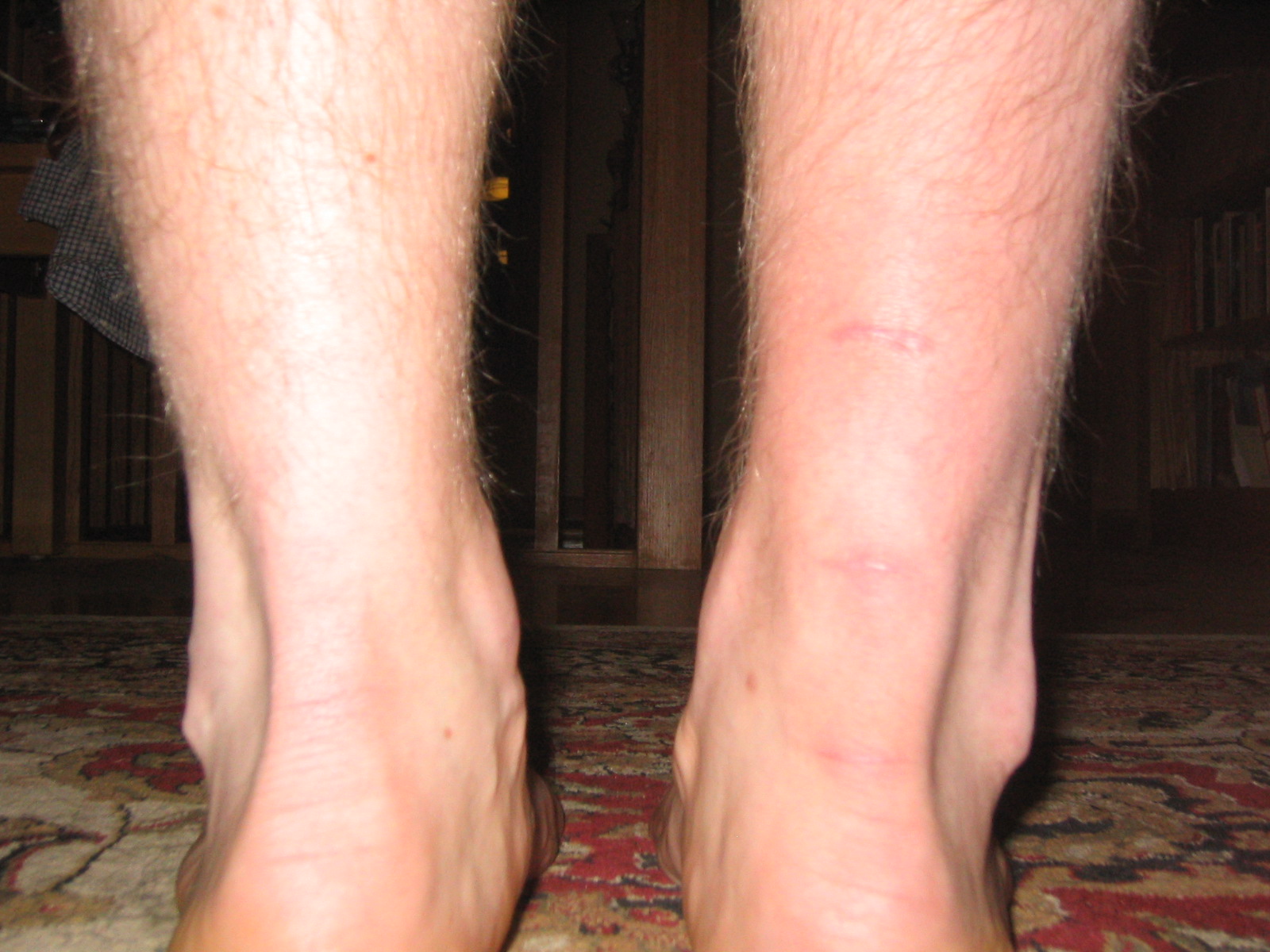
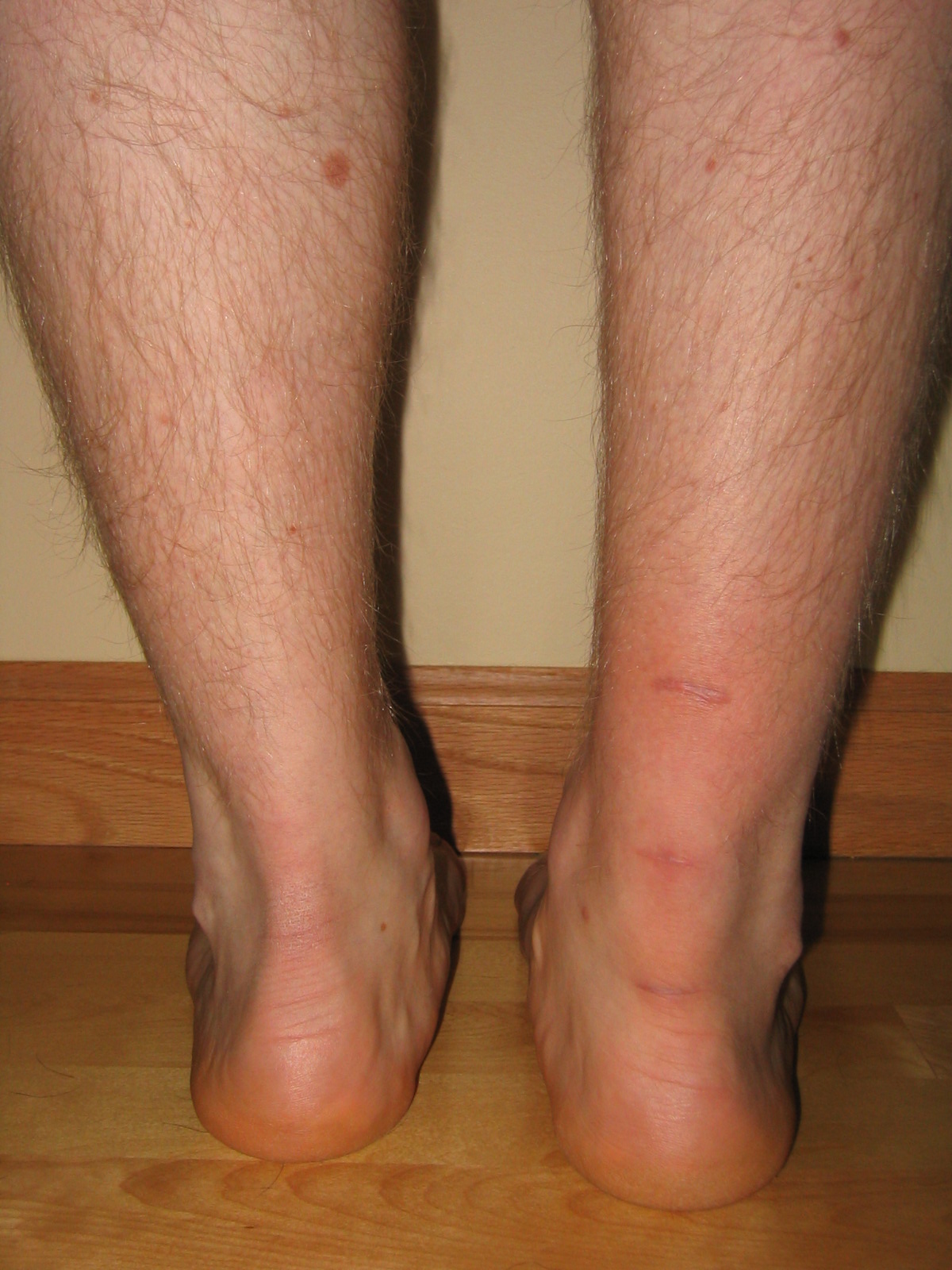
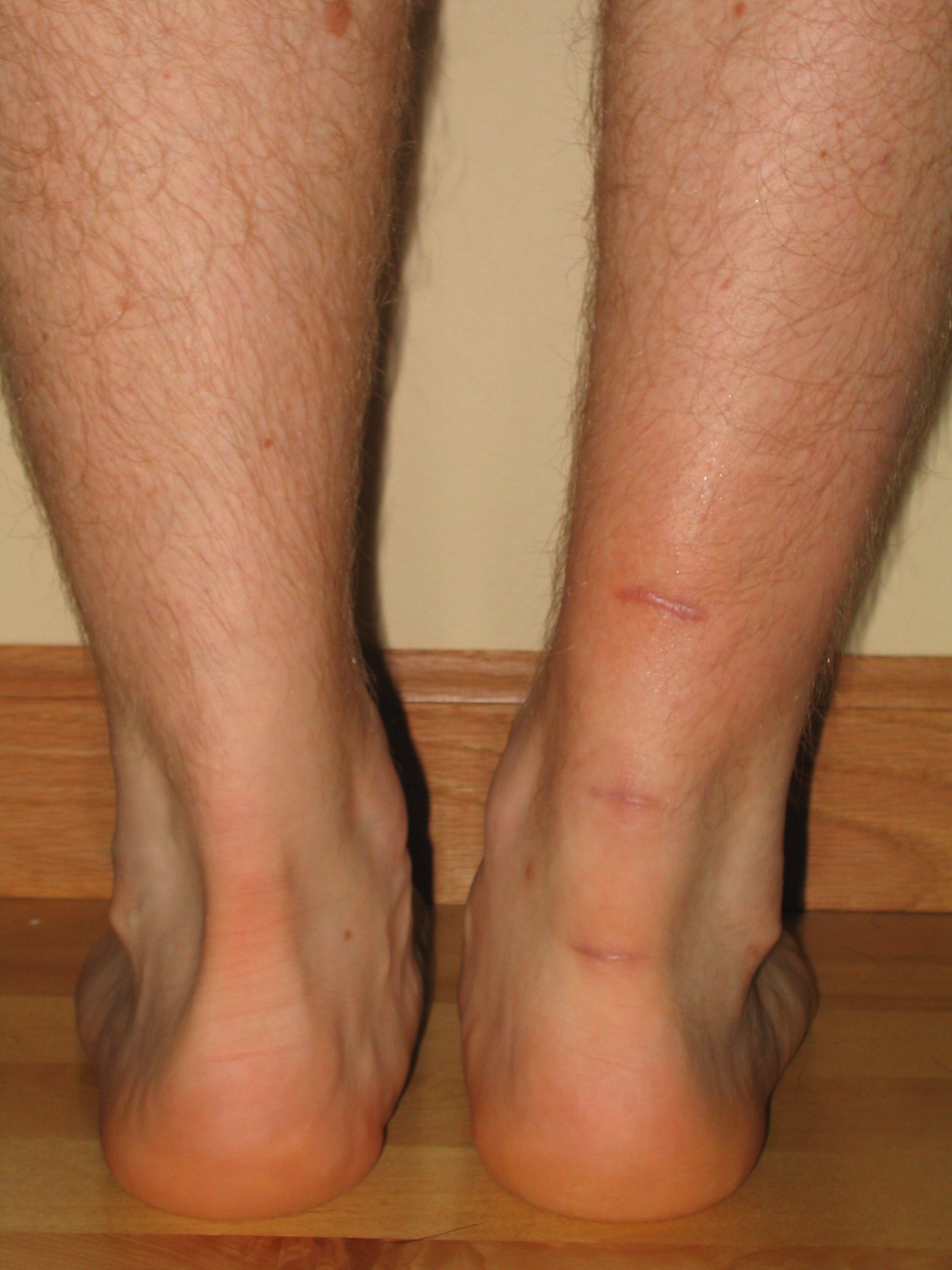
It’s hard to believe that 4 months have past since suffering the ruptured Achilles.  I still remember the actual rupture like it happened yesterday, but most of the recovery has started to become a blur.  I guess that’s probably a good thing - maybe an indication that the mental recovery is progressing along with the physical.  Attached below are a couple of pictures comparing the injured and healthy legs. 


picture-004a.jpg     picture-010a.jpg

As you can see, there isn’t too much difference since the 3 month post-op pictures.  That’s actually a bit telling for where I’m at with recovery right now.  I seem to be on this endless plateau.  I can feel some of the strength has returned to my calf and I’m moving around pretty well.  But, I just can’t seem to completely shake the limp.  I have days where it is almost unnoticeable, but then follow that up with a couple of days where I don’t feel much better than I did a month ago.  These are the days that I have to remind myself that a ruptured Achilles is a serious injury, and you can’t expect to be bounce back right away.  I’m also trying to find that balance at the gym of doing enough that I feel like I’m pushing myself and rebuilding the strength in my leg, yet not doing too much that my leg is sore the rest of the day.  Hopefully I find that balance soon.

One step of progress that I can mention is that I’ve started to do a little bit of “jogging”.  It certainly isn’t pretty, but I’m moving faster than a walking pace.  I’ve done a few interval sessions on the treadmill where I jog for two minutes and then walk for two minutes, only lasting a total of 20 minutes.  I actually made it up to 12 min. miles!  I don’t feel any pain while jogging, which is good, but the lack of strength in the calf means that I can’t stay up on my toes long enough to get a good push off.  However, this was to be expected at this point.  It will likely take several months before I return to good running form.

I’ve also hit the 8 mile mark on the marathon tracker!  The parallel starting routes have now merged and I’m making my way through Brooklyn.  Relating recovery back to an actual marathon, this is the point where you need to regain your focus.  The adrenaline and emotions from the start have died down and there are less people cheering you on.  You have to remember to relax and try and enjoy the ride.  Set your focus on making it to the next water stop.

Also, I’ve updated the poll on the left sidebar.  I had a suggestion to post a question regarding feeling any precursing pain in the days/months/years leading up the actual rupture.  As I’ve previously blogged about, I’ve felt minor stiffness in my Achilles for years and had a feeling that I’d experience a rupture at some point in my life, but I didn’t expect it on January 3, 2008.  What was your experience prior to the rupture?  Did you experience any pain or tendonitis/tendonosis?  Feel free to click on the option that best describes your Achilles experience.

Summarizing the previous poll, the results were, frankly, inconclusive.  19 people responded to the poll question asking if you injured your dominant or non-dominant foot.  The non-dominants held a slight lead at 10-9.  Obviously this is too small of a sample size to draw any conclusions.  But, it is kind of interesting that we were right at a 50/50 split.

Happy healing everyone!

A Walk in the Woods

trailsign.gif

I spent the past weekend along the north shore of Lake Superior. This is a popular vacation destination in Minnesota, especially for outdoor enthusiasts. The north shore is littered with state parks containing numerous trails leading to spectacular views of waterfalls, wildlife, and the grandest Great Lake. This was actually a trip that was originally planned for mid-January. The plan was to spend a long weekend x-country skiing and snowshoeing on the various trails. Unfortunately, my tendon rupture forced us to change our plans. We decided to postpone the trip until April, knowing I’d be a bit more mobile then. Unfortunately, we had to ditch the skis and snowshoes and settle for a walk in the woods.

We actually took a couple of hikes over the weekend. Neither of any great distance, but it was nice to challenge my balance on the uneven surfaces of the trails. It was also nice to walk on the more forgiving softness of the trails for a change rather than hard sidewalks. For the most part, everything felt pretty good. I still don’t have much strength in the calf and my leg tires a bit more quickly, but the shorter distance hikes were pretty comfortable. It was a bit humbling to go on a hike and not be able to bound around like a ten year old. I normally enjoy hiking for that exact reason. I’m always looking for the challenging routes, enjoying the opportunity to scramble over rocks or hop across a low flowing stream.

However, on this weekend I found great joy just making my way along the easy trails while seeking the path of least resistance. There were a few challenges along the way as portions of the trails were still covered with snow and ice. I forced myself to take it very easy through these sections, even excepting the outstretched hand of my girlfriend from time to time! Although my steps are still a bit shorter than normal, it was nice to take another step towards a full recovery.

Exercise Chart

guinness.jpg

I’ve been back in the gym for a couple of weeks now. I have to say that this has probably been the toughest phase, mentally, of recovery so far. Initially there was always something new coming up in a week or two - new cast, boot, partial weight bearing, full weight bearing, walking, getting rid of crutches, back into a pair of shoes, etc. Even though it felt like an eternity, there was always something new. But, now there isn’t that definitive carrot to chase. Obviously, the goal now is to re-stretch the tendon, regain full range of motion and rebuild strength in the calf as well as the rest of the injured leg. But, it’s harder to get excited about the progress. I keep telling myself that I need to listen to my own advice and look at progress week by week rather than day by day. I think my next milestone will be jogging again. But, it’s difficult to know if that is a week away or a month. I guess I just need to be patient and accept (again) that this is a serious injury with a lengthy recovery. And, a Guinness from time to time can’t hurt!

I’ve gathered up a number of exercises from my time so far at PT. I’m only going once a week now, so I do most of the work at home and in the gym. I made up a simple chart to keep the exercises organized and so I remember to do them all, as well as to track my progress. Here is a link to the Exercise Chart. Also, PDF version, in case you don’t have Excel.

I realize that this might not be useful right now for most, but it seems like a lot of people will be getting back to the gym in the next month or so. I do the exercises listed in blue every day, mainly ROM, stretching, and balance. The other exercises I do every other day. About 80% of the exercises are straight from PT. I’ve added a few additional that I feel comfortable with just for a bit of variety. I also try to include some cardio work, either biking, elliptical, or treadmill, during my workouts and I do some simple pool workouts about every other day. Feel free to copy and adjust the chart accordingly to fit your recovery. Also, let me know if you have any questions about any of the exercises.

I’m finding out that it is important to really listen to your body as you start to rebuild the calf and tendon. I’ve had days where I feel a little bit of pain while doing certain exercises. At first I tried to ignore the pain, figuring it was just part of recovery. But, when it didn’t go away after a couple days, I realized I was pushing things a little too hard. I’m now doing a better job of backing off, even though it’s a feeling of regression.

I’ve also realized that good communication with your physical therapist is very important. I always hate the question of “how does everything feel?” When compared to how I felt after the rupture, everything feels great. And, I’ve never gone through a rupture before, so I don’t know what “normal” should feel like at this point of recovery. But, I’ve found that it is really helpful to describe to your therapist any pain or tightness. They will be able to make some manipulations with your ankle or adjust your therapy slightly which may eliminate or lessen any uncomfortable feelings.

Cost of Health Care

healthcarecost.gifHas anyone else been tracking their medical expenses from this injury?  Sure makes me happy that I was insured when the injury happened.  Granted, I probably would have opted for the non-surgical treatment if I didn’t have insurance, but the cost is still staggering.  I’m also glad that I was able to make a choice with regards to treatment based on what was best for my long term well being.


I don’t want this to turn into a health care debate, so I’ll hold back any commentary regarding health insurance.  I’m just curious about the expense involved with this relatively routine surgery.  I can’t even begin to imagine the cost involved with open heart surgery, cancer treatments, etc.

piggybank320.jpgI believe I’m closing in on $11,000.  This includes ER visit, pain meds, crutches, surgery, casts, boot, post op visits, etc.  The only thing not included is physical therapy.  I’m guess that with PT added in I’ll be  over $12,000.  I can think of a lot better ways to spend $12,000.  The good news is that I have a high deductible HSA through work, so I was 100% covered as soon as I hit the deductible limit.  That probably occurred sometime around when they stuck the IV in my arm before surgery!  The bad news is that my HSA is now drained.

Anyone else care to share what their medical expenses have been so far?